

Choosing the Right Mortgage for Your First Home: A Comprehensive Guide
By Alex Thompson, Certified Financial Planner
Understanding Your Financial Readiness: The Essential First Step
Before you even begin to browse listings or speak with real estate agents, the most critical phase in choosing the right mortgage involves a deep dive into your personal finances. Lenders will scrutinize your financial health, and so should you. This self-assessment will determine how much home you can truly afford and what mortgage options are available to you.
Assessing Your Budget and Debt-to-Income Ratio (DTI)
Your budget is the bedrock of your home-buying plan. Start by meticulously itemizing your monthly income and expenses. Consider all sources of income, and account for every outgoing cost, from rent and utilities to groceries, transportation, and discretionary spending. A crucial metric lenders use is your Debt-to-Income (DTI) ratio, which compares your total monthly debt payments to your gross monthly income. Most lenders prefer a DTI of 36% or lower, though some might go up to 43% or even 50% for certain loan types, especially with higher credit scores or substantial down payments.
- Calculate Your Front-End DTI: This considers your potential new housing payment (mortgage principal, interest, property taxes, homeowner’s insurance, and HOA fees, if applicable) against your gross monthly income. Lenders typically look for this to be no more than 28-31%.
- Calculate Your Back-End DTI: This includes all your monthly debt payments (car loans, student loans, credit card minimums, personal loans) plus your potential new housing payment, divided by your gross monthly income.
Practical Tip: Use an online DTI calculator, or simply add up all your minimum monthly debt payments (including your estimated future mortgage) and divide it by your gross monthly income. If your DTI is high, focus on paying down debts before applying for a mortgage.
Your Credit Score: A Key to Favorable Terms
Your credit score is a numerical representation of your creditworthiness and is paramount in determining the interest rate you’ll be offered. A higher score typically translates to lower interest rates, saving you tens of thousands of dollars over the life of a loan. While minimum scores vary by loan type (e.g., FHA loans may accept scores as low as 580, conventional loans often require 620+, and preferred rates start at 740+), striving for the highest possible score is always beneficial.
- What Affects Your Score: Payment history (35%), amounts owed (30%), length of credit history (15%), new credit (10%), and credit mix (10%).
- How to Improve It: Pay bills on time, keep credit utilization low (below 30% of your available credit), avoid opening new lines of credit, and dispute any errors on your credit report.
Actionable Step: Obtain your free credit report from AnnualCreditReport.com and review it for accuracy. Consider a credit monitoring service to track changes.
The Down Payment: How Much to Save
The down payment is the initial amount of cash you put towards the purchase of your home. While the traditional 20% down payment helps you avoid Private Mortgage Insurance (PMI) on conventional loans, it’s certainly not the only option. Many loan programs, especially government-backed ones, allow for much lower down payments, sometimes as little as 3.5% (FHA) or even 0% (VA, USDA).
- Impact of Down Payment: A larger down payment reduces your loan amount, leading to lower monthly payments and less interest paid over time. It can also open doors to better interest rates.
- Sources of Funds: Personal savings, gifts from family members (with a gift letter), down payment assistance programs, or even 401(k) loans (though this option comes with risks).
Real-world Example: On a $300,000 home, a 20% down payment is $60,000. A 3.5% FHA down payment is $10,500. While the lower amount is more accessible, the $10,500 down payment would likely incur mortgage insurance, whereas the $60,000 would not on a conventional loan.
Emergency Fund: Your Safety Net
It’s vital to maintain an emergency fund even after you’ve saved for your down payment and closing costs. Homeownership comes with unexpected expenses – a leaky roof, a broken appliance, or unforeseen repairs. Financial experts recommend having at least three to six months’ worth of living expenses stashed away post-purchase to cover these eventualities without jeopardizing your mortgage payments.
Practical Tip: Factor your post-purchase emergency fund into your overall savings goal, rather than using all your liquid assets for the down payment and closing costs.
Deciphering Mortgage Types: Fixed-Rate vs. Adjustable-Rate
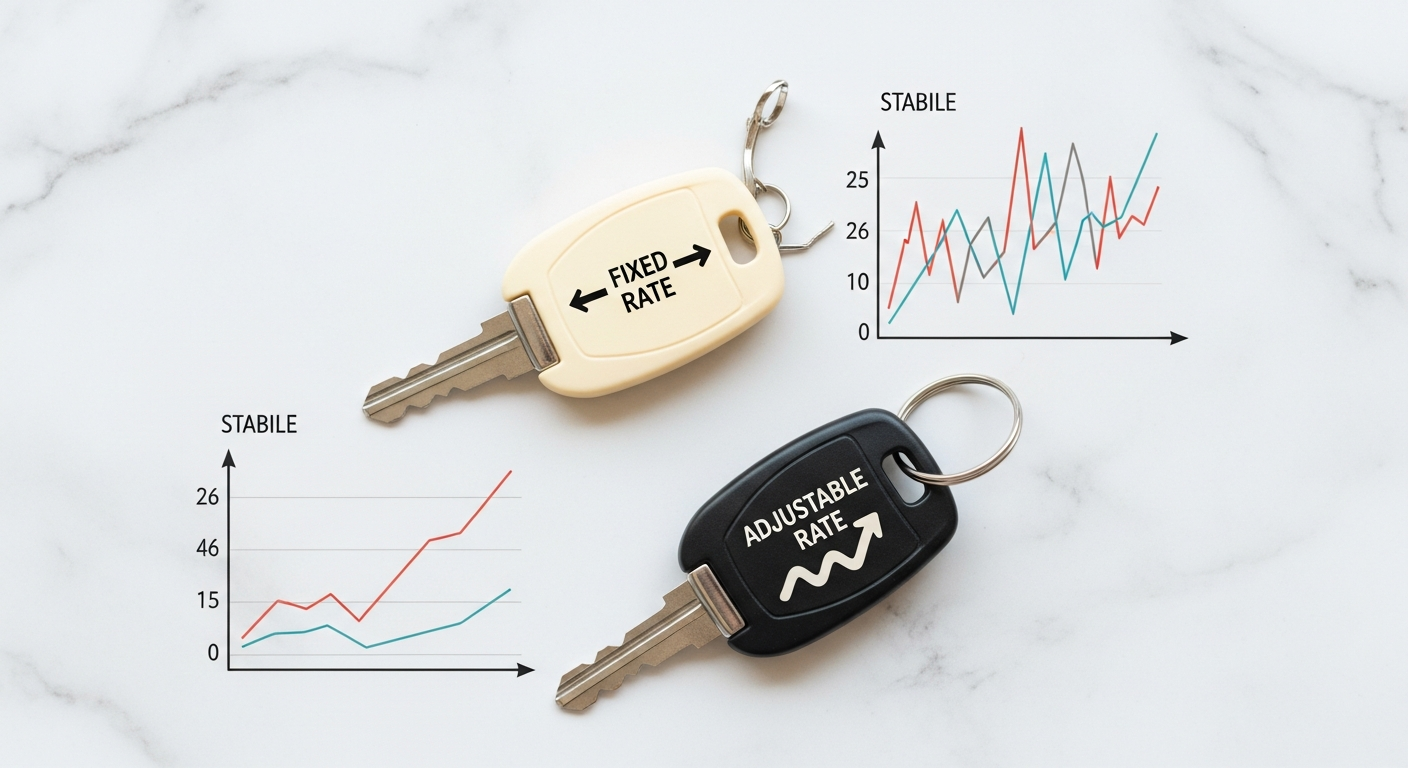
Once you understand your financial standing, the next crucial step in choosing the right mortgage is to explore the fundamental types available. The choice between a fixed-rate mortgage (FRM) and an adjustable-rate mortgage (ARM) often depends on your comfort with risk, your long-term plans, and the prevailing interest rate environment.
Fixed-Rate Mortgage (FRM)
The fixed-rate mortgage is the most popular choice for first-time homebuyers, primarily due to its predictability and stability. With an FRM, your interest rate remains constant for the entire duration of the loan, meaning your principal and interest payment will never change.
- How it Works: The interest rate is locked in at closing and does not fluctuate. Your monthly payment (principal and interest) stays the same, making budgeting straightforward.
- Common Terms: The most common fixed-rate terms are 30 years and 15 years.
- 30-Year Fixed: Offers the lowest monthly payments, freeing up cash flow for other expenses or savings. However, you’ll pay more interest over the life of the loan.
- 15-Year Fixed: Comes with a higher monthly payment but allows you to pay off your home faster and significantly reduces the total interest paid.
- Pros:
- Predictability: Stable monthly payments simplify budgeting.
- Security: Protects you from rising interest rates.
- Simplicity: Easy to understand and manage.
- Cons:
- Higher Initial Rates: Often have a slightly higher interest rate than the initial period of an ARM.
- Less Flexibility: If market rates drop significantly, you’d need to refinance to take advantage of lower rates.
- Ideal For: Homebuyers planning to stay in their home for many years, those who prioritize stable monthly expenses, and individuals with a lower risk tolerance.
Practical Tip: If considering a 15-year fixed, ensure your budget can comfortably handle the higher monthly payment. The long-term savings can be substantial; for example, on a $250,000 loan at 6.5%, a 30-year FRM might cost over $300,000 in interest, while a 15-year FRM might be under $150,000.
Adjustable-Rate Mortgage (ARM)
An adjustable-rate mortgage offers an initial fixed interest rate for a set period, after which the rate adjusts periodically based on a predetermined index. While they can start with lower interest rates than FRMs, they introduce an element of uncertainty.
- How it Works: An ARM is structured with an initial fixed period (e.g., 3, 5, 7, or 10 years), followed by adjustment periods (usually annually). For instance, a 5/1 ARM means the rate is fixed for the first five years, then adjusts once a year thereafter.
- Components:
- Index: A benchmark interest rate (e.g., SOFR, CMT) that the lender doesn’t control.
- Margin: A fixed percentage added to the index by the lender.
- Rate Caps: Limits on how much the interest rate can change during an adjustment period (periodic cap) and over the life of the loan (lifetime cap). For example, a “2/2/5” cap means the rate can’t increase by more than 2 percentage points at the first adjustment, 2 points at subsequent adjustments, and 5 points over the life of the loan.
- Pros:
- Lower Initial Rates: Often offers a lower interest rate during the initial fixed period, resulting in lower initial monthly payments.
- Potential Savings: If you plan to move or refinance before the fixed period ends, or if interest rates are expected to fall, an ARM could be more cost-effective.
- Cons:
- Payment Uncertainty: Your monthly payments can increase significantly when the rate adjusts, making budgeting more challenging.
- Complexity: Understanding indexes, margins, and caps requires careful attention.
- Ideal For: Homebuyers who anticipate selling or refinancing within the initial fixed-rate period, those who expect their income to increase significantly in the near future, or individuals who are comfortable with potential payment fluctuations and higher risk.
Actionable Step: If considering an ARM, calculate your potential maximum monthly payment by applying the lifetime cap to the current index plus margin. Ensure you can comfortably afford this “worst-case scenario” payment.
Exploring Other Mortgage Options: Government-Backed Loans and Beyond
Beyond the fixed and adjustable rates, there are several specialized mortgage programs designed to make homeownership more accessible, particularly for first-time buyers. These government-backed loans come with unique benefits and eligibility requirements, making them excellent options for many.
FHA Loans (Federal Housing Administration)
FHA loans are insured by the Federal Housing Administration, making them a popular choice for first-time homebuyers with less-than-perfect credit or limited funds for a down payment.
- Key Benefits:
- Low Down Payment: As little as 3.5% down, making homeownership more accessible.
- Lenient Credit Requirements: Lenders may approve borrowers with credit scores as low as 580 (though some prefer 620+).
- Assumable: Can be assumed by a future buyer, potentially making your home more attractive when selling.
- Potential Drawbacks:
- Mortgage Insurance Premium (MIP): Requires both an upfront MIP (1.75% of the loan amount, often financed) and an annual MIP (0.45% to 1.05% of the loan amount, paid monthly), which typically lasts for the life of the loan unless you put down 10% or more, in which case it drops after 11 years.
- Property Standards: The home must meet FHA appraisal standards, which can be stricter than conventional appraisals.
- Ideal For: Buyers with lower credit scores, limited savings for a down payment, or higher DTI ratios.
Real-world Example: A buyer with a 620 credit score and only $10,500 saved for a down payment on a $300,000 home might struggle to get a conventional loan but could easily qualify for an FHA loan with 3.5% down.
VA Loans (Department of Veterans Affairs)
VA loans are an incredible benefit for eligible service members, veterans, and surviving spouses, offering some of the most favorable terms available.
- Key Benefits:
- No Down Payment: Qualified borrowers can finance 100% of the home’s value.
- No Private Mortgage Insurance (PMI): A significant cost saving compared to conventional loans with low down payments and FHA loans.
- Competitive Interest Rates: Often offer rates lower than conventional or FHA loans.
- Flexible Credit Requirements: Generally more forgiving than conventional loans.
- Eligibility: Requires a Certificate of Eligibility (COE) demonstrating qualifying service.
- Potential Drawbacks:
- VA Funding Fee: A one-time fee (ranging from 1.4% to 3.6% of the loan amount, depending on down payment and prior VA loan usage) that helps offset the cost to taxpayers. This fee can be waived for veterans receiving VA disability compensation.
- Property Standards: Homes must meet VA Minimum Property Requirements.
- Ideal For: Eligible military personnel, veterans, and surviving spouses.
Actionable Step: If you or your spouse has military service, research your VA loan eligibility immediately. It could be your most advantageous option.
USDA Loans (United States Department of Agriculture)
USDA loans are designed to promote homeownership in rural and some suburban areas, offering attractive terms to eligible low-to-moderate-income families.
- Key Benefits:
- No Down Payment: Like VA loans, 100% financing is available.
- Low Mortgage Insurance: Features a much lower upfront (1% of loan amount) and annual guarantee fee (0.35% of loan balance) compared to FHA.
- Competitive Rates: Rates are often favorable.
- Eligibility:
- Geographic Restrictions: Property must be located in a USDA-eligible rural or suburban area (check the USDA eligibility map online).
- Income Limits: Borrower income cannot exceed 115% of the median income for the area.
- Ideal For: First-time buyers interested in homes in qualifying rural or suburban areas who meet income requirements.
Jumbo Loans and Other Niche Products
For homes exceeding the “conforming loan limits” set by Fannie Mae and Freddie Mac (e.g., $766,550 in most areas for 2024, higher in high-cost areas), you’ll need a jumbo loan. These typically have stricter credit and down payment requirements. Additionally, some lenders offer niche products like physician loans, which cater to doctors with unique financial situations, or interest-only mortgages, which are generally riskier and not recommended for first-time buyers.
Practical Tip: Always discuss your specific situation with a mortgage loan officer to determine which of these specialized programs you might qualify for, as they can offer significant advantages.
Navigating Interest Rates, Points, and Fees
Understanding the interplay of interest rates, mortgage points, and various fees is crucial for accurately assessing the true cost of your mortgage and making an informed decision. These elements directly impact your monthly payments and the total amount you pay over the life of the loan.
Interest Rate vs. APR: Knowing the Difference
- Interest Rate: This is the percentage charged by the lender for borrowing the principal amount. It directly determines the principal and interest portion of your monthly payment.
- Annual Percentage Rate (APR): The APR is a broader measure of the total cost of borrowing, expressed as an annual percentage. It includes the interest rate PLUS most closing costs, such as origination fees, discount points, and mortgage insurance. Because it encompasses more costs, the APR is usually higher than the interest rate.
Actionable Step: When comparing loan offers, always focus on the APR, not just the interest rate. It provides a more accurate picture of the total cost of the loan.
Mortgage Points (Discount Points)
Mortgage points, also known as discount points, are an optional upfront fee paid to the lender at closing in exchange for a lower interest rate. One point typically costs 1% of the loan amount (e.g., $3,000 on a $300,000 loan).
- When to Consider: Paying points can be a wise financial move if you plan to stay in the home for a long time. You need to calculate the “break-even point” – how long it will take for the monthly savings from the lower interest rate to offset the upfront cost of the points.
- Calculation Example: If 1 point costs $3,000 and saves you $50 per month, your break-even point is 60 months (5 years). If you plan to stay in the home longer than 5 years, paying the point is financially beneficial.
Practical Tip: Ask your lender for scenarios with and without paying points. Carefully weigh the upfront cost against your expected tenure in the home.
Understanding Closing Costs
Closing costs are a collection of fees and expenses paid at the end of a real estate transaction. They are separate from your down payment and can range from 2% to 5% (or even higher in some markets) of the total loan amount.
Common closing costs include:
- Lender Fees: Loan origination fees (for processing the loan), underwriting fees, application fees.
- Third-Party Fees:
- Appraisal Fee: Paid to an independent appraiser to determine the home’s market value.
- Credit Report Fee: To pull your credit history.
- Title Insurance: Protects the lender and buyer against claims to ownership of the property.
- Escrow Fees: For the escrow company handling the transaction.
- Recording Fees: To record the new deed and mortgage with the local government.
- Survey Fee: To verify property lines.
- Prepaid Expenses:
- Property Taxes: Several months’ worth of property taxes.
- Homeowner’s Insurance: First year’s premium.
- Prepaid Interest: Interest accrued from the closing date to the end of the month.
Real-world Example: On a $300,000 loan, closing costs could easily amount to $6,000 to $15,000. It’s crucial to budget for these in addition to your down payment.
Actionable Step: You will receive a “Loan Estimate” within three business days of applying for a mortgage. This document details all your loan terms, including interest rate, estimated monthly payment, and an itemized list of all closing costs. Compare Loan Estimates from multiple lenders to find the best deal.
Pre-Approval vs. Pre-Qualification: What You Need to Know
When you start seriously considering homeownership, you’ll encounter the terms “pre-qualification” and “pre-approval.” While they sound similar, they represent very different levels of commitment and provide distinct advantages in the home-buying process, especially when you are choosing the right mortgage.
Pre-Qualification: A Quick Estimate
Pre-qualification is the initial, informal step in determining how much you might be able to borrow. It’s a quick assessment based on self-reported financial information.
- Process: You provide a lender with basic information about your income, debts, and assets. The lender gives you an estimate of how much you could potentially borrow, without verifying any of the information.
- Purpose: It gives you a rough idea of affordability, helping you set a general price range for your home search. It’s a good starting point for your financial planning.
- Limitations: Since no information is verified, a pre-qualification is not a guarantee of a loan. It holds little weight with sellers and real estate agents.
Practical Tip: Think of pre-qualification as a helpful personal budgeting tool, but not something to rely on when making an offer on a home.
Pre-Approval: A Stronger Commitment
Pre-approval is a much more thorough and valuable step. It signifies a conditional commitment from a lender to provide you with a mortgage up to a specific amount, subject to a property appraisal and final underwriting.
- Process: You submit a formal mortgage application and provide extensive documentation, including pay stubs, W-2s, bank statements, tax returns, and permission for a credit check. The lender reviews and verifies this information, then issues a pre-approval letter stating the maximum loan amount you qualify for, often with an estimated interest rate.
- Purpose:
- Credibility with Sellers: A pre-approval letter demonstrates to sellers and their agents that you are a serious and qualified buyer, giving you a competitive edge, especially in a seller’s market.
- Clarifies Borrowing Power: It clearly defines your budget, narrowing down your home search to properties you can realistically afford.
- Streamlines the Process: Having most of your financial documents already reviewed can speed up the later stages of the mortgage application.
- Validity: Pre-approval letters typically have an expiration date, usually 60 to 90 days. You may need to update your financial information if you haven’t found a home by then.
Actionable Step: Secure a pre-approval from at least one lender before you start seriously house hunting. This will strengthen your offers and make your home search more efficient and realistic.
The Mortgage Application Process: From Submission to Closing
Once you have a pre-approval in hand and a specific property under contract, the actual mortgage application process begins. This phase involves a detailed review of your finances and the property itself, culminating in the joyous day of closing.
1. Choosing Your Lender Wisely
Even if you received a pre-approval from one lender, it’s wise to shop around. Different lenders offer different rates, fees, and customer service. You can choose from:
- Retail Banks: Large national banks (e.g., Chase, Wells Fargo) or local community banks.
- Credit Unions: Member-owned, often offering competitive rates and personalized service.
- Mortgage Brokers: Intermediaries who work with multiple lenders to find you the best deal.
- Online Lenders: Companies like Rocket Mortgage or Better.com offer streamlined digital processes.
Practical Tip: Apply to at least three to five lenders within a 14-day window. This period is typically treated as a single credit inquiry by credit bureaus, minimizing the impact on your credit score. Compare their Loan Estimates side-by-side, focusing on the APR, closing costs, and customer service reviews.
2. Submitting Your Formal Application
This is where you formalize your intent to borrow for a specific property. You’ll resubmit all the documents you provided for pre-approval, along with additional information related to the specific home you’re purchasing. Be prepared to provide:
- Recent pay stubs (last 30-60 days)
- W-2 forms (last two years)
- Tax returns (last two years)
- Bank statements (last 60 days for all accounts)
- Investment account statements
- Proof of down payment funds (and gift letters, if applicable)
- Explanation for any credit anomalies
Actionable Step: Organize all your financial documents in advance. Respond promptly and thoroughly to any requests for additional information from your lender to avoid delays.
3. Underwriting: The Deep Dive
After your application is submitted, it goes into “underwriting.” This is where the lender’s underwriter meticulously reviews all your financial documents, credit history, and the property’s details to assess the risk of lending to you. They verify income, employment, assets, and debts. This stage ensures that you meet all loan program guidelines and that the loan is a sound investment for the lender.
Practical Tip: Avoid making any major financial changes during this period, such as opening new credit cards, making large purchases, or changing jobs, as these can jeopardize your loan approval.
4. Appraisal and Home Inspection
- Appraisal: The lender will order an appraisal to determine the fair market value of the home. This ensures that the loan amount is justified by the property’s value. If the appraisal comes in lower than the purchase price, you may need to renegotiate with the seller or bring additional funds to closing.
- Home Inspection: While not required by the lender, a home inspection is highly recommended for buyers. A professional inspector evaluates the home’s condition, identifying potential issues with the foundation, roof, plumbing, electrical systems, etc. This helps protect you from unforeseen repair costs after closing.
Real-world Example: If you’re buying a home for $300,000 but the appraisal comes in at $290,000, the lender will only lend up to $290,000. You’d then need to either make up the $10,000 difference out of pocket, renegotiate the price with the seller, or walk away from the deal (if your contract allows).
5. Conditional Approval & Closing Disclosure
If all goes well, you’ll receive a conditional approval, meaning the loan is approved pending a few final items. Once these are cleared, the lender will issue a “Closing Disclosure” (CD) at least three business days before closing. This document is a final breakdown of all loan terms, fees, and costs. It must closely match the initial Loan Estimate you received.
Actionable Step: Compare your Closing Disclosure meticulously with your last Loan Estimate. Question any discrepancies immediately. This is your final chance to understand every financial detail before you sign.
6. Closing Day
The big day! At closing, you’ll sign numerous documents, including the promissory note (your promise to repay the loan) and the mortgage or deed of trust (giving the lender a claim on your property if you default). You’ll pay your remaining down payment and closing costs, and the funds will be disbursed. Once all papers are signed and recorded, you’ll officially receive the keys to your first home!
Common Pitfalls and How to Avoid Them
The journey to homeownership is complex, and first-time buyers can easily stumble into common pitfalls. Being aware of these traps and knowing how to sidestep them is key to successfully choosing the right mortgage and enjoying a smooth closing.
1. Changing Your Financial Situation After Pre-Approval
One of the most frequent mistakes is making significant financial changes between pre-approval and closing. Lenders check your credit and employment again just before closing.
- Pitfall:
- Taking on new debt (e.g., buying a car, opening new credit cards).
- Quitting your job or changing careers.
- Making large, unexplained deposits or withdrawals from your bank accounts.
- Missing bill payments.
- How to Avoid: Maintain financial stability. Keep your credit utilization low, avoid new debt, and don’t make any major financial moves without consulting your loan officer first.
2. Not Shopping Around for Lenders
Many first-time buyers settle for the first lender they speak with, or simply go with their current bank, potentially missing out on better rates and terms.
- Pitfall: Accepting the first offer, assuming all lenders are the same. A difference of just 0.25% on an interest rate can cost tens of thousands of dollars over the life of a 30-year loan.
- How to Avoid: Obtain Loan Estimates from at least three to five different lenders (banks, credit unions, mortgage brokers). Compare the APR, closing costs, and overall customer service.
3. Overlooking or Underestimating Closing Costs
While most buyers budget for a down payment, many are surprised by the additional expense of closing costs, which can add 2-5% (or more) to the purchase price.
- Pitfall: Not saving enough for closing costs, leading to stress or delaying closing.
- How to Avoid: Budget for closing costs from the outset. Expect them to be 3-5% of the loan amount, and keep these funds separate from your down payment savings. Review your Loan Estimate carefully for all listed fees.
4. Not Understanding All Loan Terms
The mortgage industry uses complex terminology. Failing to grasp key terms can lead to unexpected costs or dissatisfaction later.
- Pitfall: Signing documents without fully understanding the implications of your interest rate, APR, mortgage insurance, escrow accounts, or pre-payment penalties (though less common today).
- How to Avoid: Ask questions! Your loan officer is there to explain everything. If something is unclear, ask for clarification until you fully understand. Do your own research using reputable sources like Diaal News.
5. Focusing Solely on the Lowest Interest Rate
While an attractive interest rate is crucial, it’s not the only factor in choosing the right mortgage. A slightly higher rate might come with significantly lower closing costs or better customer service, which could be more beneficial depending on your situation.
- Pitfall: Prioritizing the lowest advertised interest rate without considering the overall APR, points, fees, or the lender’s reputation.
- How to Avoid: Look at the holistic picture provided by the Loan Estimate. Compare the APR, which includes most fees, and consider the total cash required at closing. A trusted lender with slightly higher fees might offer better service, which is invaluable during a stressful transaction.
6. Neglecting Your Long-Term Financial Goals
Your mortgage should fit into your broader financial plan, not just your immediate home purchase. Consider how your chosen mortgage type (fixed vs. adjustable, 15-year vs. 30-year) impacts your retirement savings, investment goals, or future family plans.
- Pitfall: Opting for the lowest monthly payment (e.g., 30-year fixed) without considering if a higher payment (e.g., 15-year fixed) could save hundreds of thousands in interest over time, aligning better with long-term wealth building. Or choosing an ARM when you plan to stay long-term.
- How to Avoid: Envision your life 5, 10, or 15 years down the road. Will you stay in this home? Do you plan to pay off debt aggressively? Do you anticipate income changes? Choose a mortgage that supports these future aspirations. Consulting a financial advisor can be immensely helpful here.
By being proactive and informed, you can steer clear of these common missteps, ensuring your first home purchase is a positive and financially sound experience.
Conclusion: Empowering Your First Home Journey
Buying your first home is a monumental step, and choosing the right mortgage is arguably the most critical decision in that journey. It’s not merely about securing a loan; it’s about laying a stable financial foundation for your future, ensuring your dream home remains a source of joy, not stress. We’ve traversed the landscape from understanding your personal financial readiness to deciphering complex loan types, navigating rates and fees, and ultimately guiding you through the application and closing process.
Remember, the “right” mortgage isn’t a universal one-size-fits-all solution. It’s deeply personal, reflecting your unique income, expenses, credit profile, down payment capabilities, and long-term financial goals. Whether you lean towards the predictability of a fixed-rate loan, the initial savings of an ARM, or the specialized benefits of government-backed options like FHA or VA loans, the power of an informed choice is in your hands.
Armed with the insights from Diaal News, you are now equipped to approach lenders with confidence, ask the right questions, compare offers judiciously, and avoid common pitfalls. Don’t rush the process. Take your time, do your due diligence, and seek advice from trusted mortgage professionals and financial advisors when needed. Your diligence today will translate into financial peace of mind for years to come.
Your next step: Begin by assessing your current financial health using the practical tips outlined in this guide. Check your credit score, calculate your DTI, and estimate your realistic down payment. From there, explore the mortgage options that best align with your findings. Your dream home awaits, and the journey begins with an empowered, informed decision about your mortgage.
Frequently Asked Questions