
Large-scale civil infrastructure projects—including highway bridges, industrial pipe racks, pedestrian walkways, high-rise commercial buildings, and long-span steel structures—are subjected to continuous dimensional changes driven by ambient thermal expansion, concrete shrinkage, wind sway, and dynamic live traffic loads. When long structural elements are rigidly restrained against thermal movement, severe internal thermal stresses accumulate within girders, structural piers, support abutments, and foundation anchorages. Over time, these unmitigated thermal forces cause structural cracking, connection fatigue, bolt shearing, and costly foundation damage.
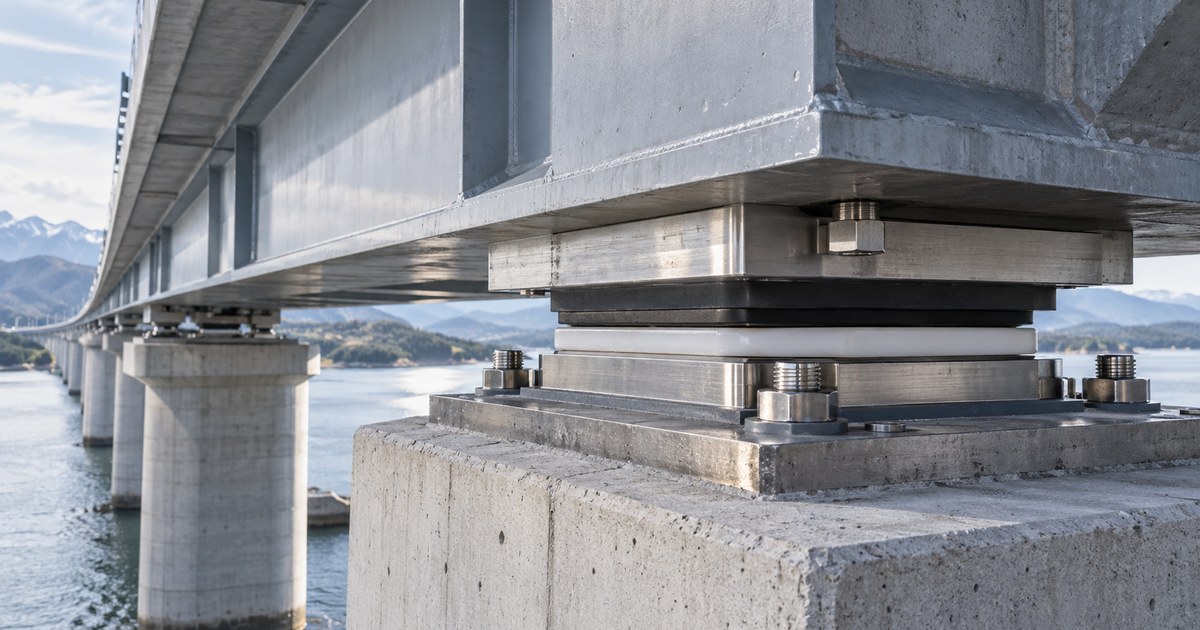
To accommodate horizontal thermal expansion, contraction, and angular rotational deflections, structural engineers incorporate low-friction slide bearings into bridge seats and structural connection details. These specialized bearing assemblies isolate thermal expansion forces, allowing structural spans to expand and contract smoothly while transferring massive vertical dead and live loads safely into supporting substructures.
Mechanics of Low-Friction PTFE Slide Surfaces
Modern structural slide bearings rely on Polytetrafluoroethylene (PTFE) sliding interfaces coupled with polished stainless steel backing plates. PTFE exhibits one of the lowest static and dynamic friction coefficients among solid engineering materials, typically ranging between 0.02 and 0.08 under heavy structural loads.
The friction coefficient of PTFE is non-linear and inversely proportional to contact pressure: as vertical compressive load increases, the coefficient of sliding friction decreases significantly. To optimize friction performance, structural engineers design bearing pad surface contact areas to maintain compressive pressures between 1,000 and 3,000 PSI, minimizing sliding resistance while staying safely within the compressive yield strength and creep limits of the PTFE material.
Composite Bearing Assemblies for Multi-Directional Movement
A high-performance structural expansion bearing assembly typically consists of a top sliding element and a resilient elastomeric bottom pad. The top element incorporates a mirror-polished 316 stainless steel plate sliding against a virgin or glass-filled PTFE sheet bonded to a heavy steel substrate. The resilient elastomeric bottom pad absorbs angular rotations resulting from beam deflection under heavy dynamic live loads, maintaining uniform pressure distribution across the slide interface.
In heavy industrial, power plant, and bridge engineering applications, specifying Fabreeka expansion bearings provides a comprehensive engineering solution for combined thermal movement and rotational deflection. Integrating elastomeric fabric-reinforced pads with PTFE low-friction surfaces ensures uniform contact pressure across the entire bearing face, preventing point-loading, edge distress, and premature wear along the sliding interface under high rotational deflections.
Engineering Considerations for Long-Term Durability
Ensuring decades of maintenance-free service life for expansion bearing assemblies in harsh operating environments requires addressing critical environmental and mechanical factors during specification and design:
- Corrosion Protection: Utilizing grade 316 mirror-finished stainless steel for upper slide plates prevents surface pitting, atmospheric oxidation, and rust contamination, maintaining low-friction characteristics in coastal marine or aggressive chemical environments.
- Dust and Debris Deflectors: Incorporating protective elastomeric seals or lip deflectors around sliding interfaces prevents grit, road salt, and abrasive dirt from embedding into the soft PTFE matrix, avoiding abrasive wear and friction increases.
- Rotational Accommodation: Selecting an elastomeric backing element with sufficient pad thickness to accommodate maximum calculated beam end rotations without producing edge-loading stress concentrations or pad lift-off.
- Thermal Stability: Verifying that all bearing assembly components retain structural stability, impact toughness, and low-friction characteristics across extreme seasonal temperature ranges.
By specifying properly engineered low-friction expansion bearings, civil and structural engineers ensure long-term structural flexibility, protect critical foundation elements, and extend the operational life of heavy civil infrastructure investments.
Summary of Infrastructure Performance Advantages
In modern heavy civil construction, preventing structural distress caused by thermal expansion and contraction is essential for public safety and long-term asset management. Low-friction slide bearing assemblies absorb structural dimensional fluctuations seamlessly, drastically reducing foundation maintenance costs and protecting critical bridge piers, industrial frameworks, and heavy pipe racks across extended structural service lifespans of fifty years or more.