
ETFs vs. Mutual Funds: A Comprehensive Guide to Your Investment Choices for 2026
By diaalnews Editorial Team — Senior editors with 10+ years of subject-matter experience.
Published 2026-05-26 · Last Updated 2026-05-26
Affiliate disclosure: This article may contain affiliate links. Recommendations are independent and editorially driven.
When it comes to building a robust investment portfolio, two acronyms frequently dominate the discussion: ETFs and mutual funds. Both are popular investment vehicles designed to offer diversification and professional management, making them accessible options for investors ranging from novices to seasoned veterans. However, despite their shared purpose of pooling money to invest in a basket of securities, the underlying mechanics, cost structures, tax implications, and trading flexibilities of Exchange-Traded Funds (ETFs) and mutual funds diverge significantly. Understanding these distinctions is not merely an academic exercise; it is crucial for making informed decisions that align with your financial goals, risk tolerance, and investment horizon in 2026 and beyond.
For many, the choice between ETFs and mutual funds can feel like navigating a labyrinth of jargon and complex financial instruments. This comprehensive guide aims to demystify these investment giants, providing a clear, in-depth comparison to help you determine which vehicle, or perhaps a combination of both, best suits your personal finance strategy. We will delve into their fundamental characteristics, explore their respective advantages and disadvantages, analyze their cost structures, shed light on their tax efficiency, and discuss how they fit into different investment approaches. By the end, you’ll be equipped with the knowledge to confidently chart your investment course.
Understanding the Investment Landscape: Pooled Investments Defined
At their core, both ETFs and mutual funds represent a form of pooled investment. This means that money from numerous investors is collected into a single fund, which is then used by a fund manager to purchase a diversified portfolio of stocks, bonds, commodities, or other assets. This pooling mechanism offers several inherent advantages over individual stock picking, particularly for the average investor.
The Fundamental Goal: Growing Your Wealth Through Diversification
The primary appeal of pooled investments lies in their ability to provide instant diversification. Instead of buying individual shares of, say, ten different companies, an investor in a fund might effectively own tiny fractions of hundreds or even thousands of companies through a single purchase. This spreads risk significantly, as the poor performance of one or a few assets is less likely to severely impact the overall portfolio. Diversification is a cornerstone of sound investment strategy, helping to mitigate the impact of market volatility and individual asset risks.
Beyond risk reduction, these funds also offer professional management. While some ETFs are passively managed (tracking an index), even these require skilled oversight to ensure they accurately replicate their target benchmark. Actively managed mutual funds, on the other hand, employ dedicated teams of analysts and fund managers whose full-time job is to research, select, and manage the fund’s holdings with the aim of outperforming a specific market index.
A Brief History of Pooled Investments
Mutual funds have a longer history, originating in Europe in the late 18th century and gaining significant traction in the United States in the 20th century. Their structure as open-end funds, meaning they continuously issue and redeem shares, became the standard. ETFs, by contrast, are a more recent innovation, first appearing in the early 1990s. Born out of a desire for more flexible, tax-efficient, and lower-cost alternatives to traditional mutual funds, ETFs rapidly grew in popularity, revolutionizing how investors access diversified portfolios.
The evolution of both vehicles reflects changing investor needs and technological advancements in financial markets. Today, they coexist as powerful tools in the investor’s arsenal, each with distinct characteristics that cater to different preferences and objectives.
ETFs Explained: The Exchange-Traded Fund Advantage
Exchange-Traded Funds, or ETFs, are investment funds that hold assets such as stocks, commodities, or bonds, and are traded on stock exchanges much like individual stocks. They have garnered immense popularity due to their flexibility, transparency, and often lower costs compared to their mutual fund counterparts.
[INLINE IMAGE 1: place after second H2 | alt=”etfs vs mutual funds concept illustration”]
What Exactly is an ETF?
An ETF is essentially a basket of securities designed to track an underlying index, sector, commodity, or other asset. For instance, an S&P 500 ETF holds shares of the companies in the S&P 500 index, mirroring its performance. While most ETFs are passively managed, meaning they aim to replicate the performance of an index rather than actively trying to beat it, there’s a growing segment of actively managed ETFs that employ fund managers to make investment decisions.
A key structural difference is that ETFs shares are created and redeemed by large institutional investors (called “authorized participants”) directly with the fund in large blocks, not by individual investors. This creation/redemption mechanism is critical to how ETFs maintain a market price close to their Net Asset Value (NAV).
How ETFs Are Traded
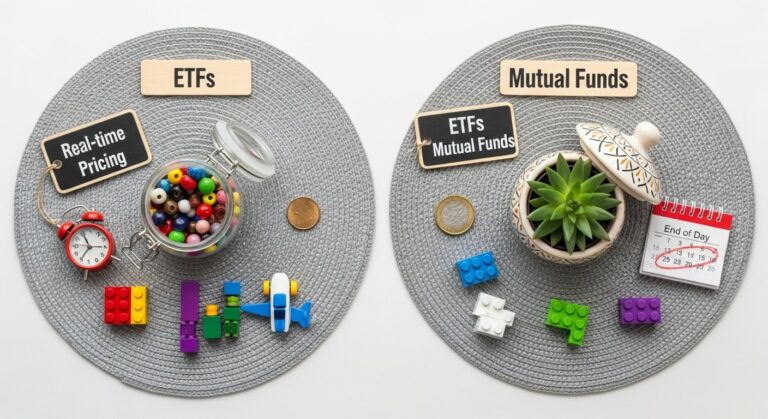
Unlike mutual funds, which are bought and sold directly from the fund company at the end-of-day NAV, ETFs trade on stock exchanges throughout the trading day. This means their price can fluctuate moment-to-moment based on supply and demand, just like individual stocks. Investors can place market orders, limit orders, and stop orders, offering a degree of trading flexibility not available with traditional mutual funds.
When an investor buys an ETF, they are purchasing shares from another investor on the open market, not directly from the fund itself. This secondary market trading mechanism is fundamental to understanding ETF pricing and liquidity.
Types of ETFs
The ETF market has exploded in variety, offering specialized funds for nearly every investment niche:
- Index ETFs: These are the most common, tracking broad market indices like the S&P 500, Dow Jones Industrial Average, or NASDAQ Composite.
- Sector ETFs: Focus on specific industries such as technology, healthcare, energy, or finance.
- Bond ETFs: Invest in various types of bonds, offering exposure to government, corporate, municipal, or international debt markets.
- Commodity ETFs: Allow investors to gain exposure to physical commodities like gold, silver, oil, or agricultural products without directly owning them.
- International ETFs: Invest in companies or bonds from specific countries or regions outside the home market.
- Actively Managed ETFs: These funds have a portfolio manager who makes investment decisions, aiming to outperform an index or achieve specific investment objectives.
- ESG ETFs: Focus on companies that meet environmental, social, and governance criteria.
- Thematic ETFs: Invest in companies related to emerging trends or long-term themes, such as artificial intelligence, clean energy, or cybersecurity.
Key Benefits of ETFs
ETFs offer several compelling advantages:
- Lower Costs: Many ETFs, particularly passive index ETFs, have significantly lower expense ratios than actively managed mutual funds, as they don’t require extensive research teams.
- Tax Efficiency: Their unique creation/redemption mechanism often results in fewer capital gains distributions to shareholders, potentially leading to lower tax liabilities.
- Trading Flexibility: ETFs can be bought and sold throughout the trading day at market prices, allowing for more precise entry and exit points.
- Transparency: Most ETFs disclose their full holdings daily, giving investors a clear picture of what they own.
- Diversification: A single ETF purchase can provide instant diversification across a broad range of assets or an entire market segment.
Potential Drawbacks of ETFs
Despite their benefits, ETFs also have some considerations:
- Brokerage Commissions: While many brokers now offer commission-free ETF trading, some still charge commissions, which can eat into returns, especially for frequent small trades.
- Bid-Ask Spreads: Because ETFs trade on an exchange, there’s a bid-ask spread (the difference between the highest price a buyer is willing to pay and the lowest price a seller is willing to accept). For thinly traded ETFs, this spread can be wider, making trades more expensive.
- Over-trading Potential: The ability to trade intraday can tempt some investors into frequent trading, potentially incurring more commissions and emotional decision-making.
- Tracking Error: Passively managed ETFs aim to perfectly track an index, but minor differences in performance (tracking error) can occur due to fees, cash drag, or sampling methods.
Mutual Funds Demystified: The Traditional Investment Vehicle
Mutual funds have been a cornerstone of personal finance for generations, offering a managed and diversified approach to investing. They operate under a different structure than ETFs, with implications for how they are priced, bought, and sold.
Defining Mutual Funds
A mutual fund is a type of professionally managed investment fund that pools money from many investors to purchase securities. The term “mutual” emphasizes that all investors in the fund share in its gains and losses proportionally. These funds are typically “open-end,” meaning they can issue an unlimited number of shares as investors buy them and redeem shares as investors sell them. The value of a mutual fund share is known as its Net Asset Value (NAV).
Mutual funds are managed by professional fund managers who actively make investment decisions (unless it’s an index mutual fund) according to the fund’s stated investment objectives. This active management is a defining characteristic for many mutual funds.
How Mutual Funds Operate (NAV, End-of-Day Trading)
Unlike ETFs, mutual funds are not traded on exchanges. Instead, investors buy and sell shares directly from the fund company or through a brokerage at the fund’s NAV. The NAV is calculated once per day, typically at the close of the financial markets (4:00 PM EST). If you place an order to buy or sell mutual fund shares, that order will be executed at the next calculated NAV. This means you don’t know the exact price you’ll pay or receive until after the market closes.
The fund creates new shares when investors buy them and redeems existing shares when investors sell them. This continuous creation and redemption process impacts the fund’s portfolio management and can have tax implications for shareholders, as will be discussed further below.
Types of Mutual Funds
The world of mutual funds is incredibly diverse, categorized by their investment objectives and the types of securities they hold:
- Equity Funds (Stock Funds): Invest primarily in stocks. These can be further broken down by company size (small-cap, mid-cap, large-cap), investment style (growth, value), or geographic focus (domestic, international).
- Bond Funds: Invest in various debt securities, aiming to generate income. They vary by credit quality (government, corporate, high-yield), maturity (short-term, intermediate-term, long-term), and tax status (taxable, tax-exempt municipal bonds).
- Balanced Funds: Invest in a mix of stocks and bonds, aiming for a balance of growth and income. The allocation typically adjusts based on the fund’s strategy.
- Money Market Funds: Invest in highly liquid, short-term debt instruments, such as Treasury bills, commercial paper, and certificates of deposit. They are generally considered very low-risk and aim to preserve capital while providing modest income.
- Index Funds: A type of mutual fund designed to passively track a specific market index, similar to many ETFs. They aim to match, rather than beat, the performance of their benchmark.
- Sector Funds: Focus on specific industries or sectors of the economy, such as technology, healthcare, or real estate.
- Target-Date Funds: Designed for retirement savers, these funds automatically adjust their asset allocation over time, becoming more conservative as the investor approaches a specific “target date” (e.g., 2045, 2050).
Key Benefits of Mutual Funds
Mutual funds have enduring popularity for good reason:
- Professional Management: For actively managed funds, seasoned professionals select and monitor the investments, saving investors time and potentially providing expertise.
- Diversification: They offer broad diversification across various securities with a single investment, reducing specific company risk.
- Convenience: Automatic investment plans and dividend reinvestment options are readily available, simplifying long-term investing.
- Accessibility: Many mutual funds have relatively low minimum initial investment requirements, making them accessible to a wide range of investors.
- Simplicity: The end-of-day pricing and direct purchase/sale mechanism can be simpler for investors who prefer not to monitor market fluctuations throughout the day.
Potential Drawbacks of Mutual Funds
Consider these potential downsides when evaluating mutual funds:
- Higher Fees: Actively managed mutual funds typically have higher expense ratios due to the costs associated with research, trading, and portfolio management.
- Sales Loads: Many mutual funds charge sales commissions (loads), either upfront (front-end load), upon selling (back-end load), or as ongoing fees (level-load). These can significantly reduce returns.
- Less Tax Efficient: The continuous buying and selling of underlying securities by the fund manager, combined with the fund’s redemption of shares, can trigger capital gains distributions to shareholders, even if the individual investor hasn’t sold any shares.
- No Intraday Trading: Orders are executed only once per day at the NAV, limiting trading flexibility compared to ETFs.
- Lack of Transparency: Actively managed mutual funds typically disclose their holdings only quarterly or semi-annually, meaning investors don’t always know exactly what the fund owns on a day-to-day basis.
Key Differences: ETFs vs. Mutual Funds at a Glance
While both ETFs and mutual funds are powerful tools for diversification and wealth accumulation, their operational differences lead to distinct experiences for investors. Understanding these core disparities is paramount to choosing the right investment vehicle for your portfolio.
[INLINE IMAGE 2: place after fourth H2 | alt=”etfs vs mutual funds comparison illustration”]
Trading Mechanics: Market Price vs. NAV
This is arguably the most significant structural difference. ETFs trade on stock exchanges like individual stocks. This means they have a continuously fluctuating market price that is determined by supply and demand throughout the trading day. Investors can buy and sell ETF shares at any point during market hours, using various order types such as market orders, limit orders, or stop-loss orders.
Mutual funds, on the other hand, are bought and sold directly from the fund company (or through a broker acting as an intermediary) at their Net Asset Value (NAV). The NAV is calculated only once per day, after the market closes. If you place an order for a mutual fund, it will be executed at that day’s closing NAV, regardless of when you placed the order during the day. This difference means you know the exact price you’re paying or receiving for an ETF at the time of the transaction, but not for a mutual fund until after the market closes.
Pricing and Valuation
The market price of an ETF can sometimes deviate slightly from its underlying NAV, especially in volatile markets or for thinly traded ETFs. This creates a “premium” or “discount” to NAV. However, the unique creation/redemption mechanism involving authorized participants helps keep the ETF’s market price closely aligned with its NAV. When an ETF trades at a premium, authorized participants can create new shares and sell them, bringing the price down. When it trades at a discount, they can buy shares and redeem them, pushing the price up. This arbitrage mechanism generally keeps the discrepancy minimal for liquid ETFs.
Mutual funds, by definition, always trade at their NAV. There is no market premium or discount because shares are bought and sold directly with the fund, which prices them daily at their precise underlying value.
Portfolio Transparency
Most ETFs offer daily transparency of their holdings. This means investors can see exactly what assets the fund holds at the end of each trading day. This high level of transparency allows investors to know precisely what they own and how closely the ETF tracks its stated objective.
Actively managed mutual funds, for regulatory reasons and to protect their proprietary trading strategies, typically disclose their holdings only quarterly or semi-annually. While index mutual funds might offer more frequent insight into their composition (as they simply follow an index), for actively managed funds, investors rely on the fund manager’s expertise without day-to-day knowledge of the specific securities held.
The Role of the Fund Manager
The role of the fund manager differs significantly, especially between actively managed funds and passively managed ones. Many mutual funds are actively managed, where a team of professionals makes continuous buy and sell decisions based on research and market outlook, aiming to outperform a benchmark index.
Many ETFs, particularly the most popular ones, are passively managed. They simply track a specific index, meaning the fund manager’s primary role is to ensure the fund accurately replicates the index’s performance, requiring less active decision-making. However, a growing number of actively managed ETFs exist, where managers employ similar strategies to their mutual fund counterparts, but within the ETF structure.
Comparative Overview: ETFs vs. Mutual Funds
To crystallize these differences, here’s a comparative table outlining the main features:
| Feature | Exchange-Traded Funds (ETFs) | Mutual Funds |
|---|---|---|
| Trading | Traded on exchanges throughout the day like stocks; prices fluctuate. | Bought/sold directly from fund company once a day at closing NAV. |
| Pricing | Market price can vary slightly from NAV; subject to bid-ask spread. | Always traded at Net Asset Value (NAV); no bid-ask spread for direct purchase. |
| Transparency | Most disclose holdings daily. | Typically disclose holdings quarterly or semi-annually (less transparent for active funds). |
| Management Style | Predominantly passive (index-tracking), but active ETFs are growing. | Can be passive (index funds) or actively managed; active management is common. |
| Fees & Costs | Generally lower expense ratios; brokerage commissions (though many are commission-free); bid-ask spread. | Often higher expense ratios for active funds; can have sales loads (front-end, back-end); 12b-1 fees. |
| Tax Efficiency | Generally more tax-efficient due to in-kind creation/redemption mechanism. | Can be less tax-efficient due to frequent capital gains distributions. |
| Minimum Investment | Price of one share (can be very low). | Often higher initial minimums ($500 – $3,000+), though some are lower. |
| Automatic Investing | Less common, requires setting up recurring buys with a broker. | Very common and easy to set up with the fund company. |
| Market Impact | Trades on secondary market don’t directly impact fund’s underlying holdings until creation/redemption. | Investor buys/sells directly with fund, requiring fund manager to buy/sell underlying assets. |
Understanding the Psychological Impact
The differing trading mechanics can also have a psychological impact on investors. The ability to trade ETFs throughout the day can lead to a temptation for frequent trading or market timing, which often proves detrimental to long-term returns. Investors might get caught up in intraday price swings, making emotional decisions.
Mutual funds, with their end-of-day pricing, inherently discourage such behavior. This structure often fosters a “set it and forget it” mentality, which aligns well with long-term, disciplined investing strategies like dollar-cost averaging. This psychological aspect is an often-overlooked but important consideration when choosing between the two.
Cost Structures and Fees: Unpacking the Expense Debate
Fees are a silent killer of investment returns. Even seemingly small percentages can compound over decades to significantly erode your wealth. Therefore, a thorough understanding of the cost structures of ETFs and mutual funds is critical. While both have fees, the types and magnitudes can differ substantially.
Expense Ratios: The Recurring Cost
The expense ratio is the most prominent and consistent fee associated with both ETFs and mutual funds. It represents the annual percentage of your investment that goes towards covering the fund’s operating expenses. These expenses include management fees, administrative costs, marketing expenses (like 12b-1 fees), and other operational overheads. For an investment of $10,000 with a 0.50% expense ratio, you would pay $50 per year.
- For ETFs: Passively managed index ETFs are renowned for their ultra-low expense ratios, often ranging from 0.03% to 0.25%. Actively managed ETFs tend to have higher expense ratios, but generally still lower than their mutual fund counterparts.
- For Mutual Funds: Actively managed mutual funds typically have higher expense ratios, often ranging from 0.50% to 1.50% or even higher for specialized funds. Index mutual funds, mirroring their ETF cousins, also boast very low expense ratios, similar to passive ETFs.
The difference of even 0.50% annually can translate to tens or hundreds of thousands of dollars over a 30-year investment horizon due to the power of compounding. When selecting a fund, always prioritize those with lower expense ratios, especially if the fund’s objective is to simply track an index.
Trading Commissions and Brokerage Fees
This category of fees primarily applies to ETFs, though it has become less prevalent due to increased competition among brokers.
- For ETFs: When ETFs were first introduced, buying and selling them incurred standard brokerage commissions, similar to trading individual stocks. However, in 2026, most major brokerage platforms offer commission-free trading for a vast selection of ETFs. If you trade frequently or your chosen ETF is not on a commission-free list, these fees can add up.
- For Mutual Funds: When buying and selling mutual funds directly from the fund company or through a broker that offers them, you typically do not pay explicit trading commissions, as the transaction is handled differently. However, this is where sales loads come into play.
Sales Loads (Front-end, Back-end, Level-loads)
Sales loads are commissions paid to brokers or financial advisors for selling mutual funds. These fees are a significant differentiator and are generally not found with ETFs (which instead might have brokerage commissions).
- Front-End Load (Class A Shares): This is a sales charge paid at the time of purchase. For example, a 5% front-end load means that if you invest $10,000, only $9,500 is actually invested, with $500 going to the sales commission.
- Back-End Load (Class B Shares): Also known as a contingent deferred sales charge (CDSC), this fee is paid when you sell your shares. The charge typically decreases over time, eventually disappearing after several years (e.g., 5-7 years).
- Level-Load (Class C Shares): These funds typically have no front-end load and a small (e.g., 1%) back-end load that might disappear after a year. However, they compensate brokers with a higher annual 12b-1 fee, making them potentially more expensive over the long term.
It’s important to note that many mutual funds, particularly those offered directly by fund companies or through employer-sponsored retirement plans, are “no-load” funds, meaning they do not charge these sales commissions. Investors should actively seek out no-load options when possible, as loads significantly detract from returns.
Other Potential Fees (Management, 12b-1, Account Maintenance)
Beyond the primary fees, both types of funds can have other, less obvious costs:
- Management Fees: This is the portion of the expense ratio specifically allocated to pay the fund managers and their teams. It’s usually higher for actively managed funds.
- 12b-1 Fees: Named after an SEC rule, these are annual fees deducted from the fund’s assets to cover marketing and distribution expenses. They are more common in mutual funds (especially Class C shares) and less so in ETFs.
- Account Maintenance Fees: Some brokerage firms or fund companies might charge small annual fees for maintaining an account, especially if the account balance falls below a certain threshold.
- Trading Costs (Embedded): Even for passive funds, there are internal trading costs when the fund buys and sells its underlying securities. These costs are reflected in the fund’s overall performance but are not explicitly charged to investors as a separate fee.
The Impact of Fees on Long-Term Returns
The cumulative effect of fees over decades cannot be overstated. Consider two identical investments of $100,000, both earning an average annual return of 7% before fees over 30 years. If one has an expense ratio of 0.20% and the other has an expense ratio of 1.20%:
- The fund with 0.20% expense ratio would grow to approximately $745,000.
- The fund with 1.20% expense ratio would grow to approximately $560,000.
That 1% difference in annual fees translates to a staggering $185,000 less in your pocket over 30 years. This stark example underscores why minimizing fees should be a paramount consideration in your investment strategy, a factor that often favors passively managed ETFs and index mutual funds over actively managed mutual funds with high expense ratios and loads. Understanding these nuances is key to effective long-term financial planning.
Trading Flexibility and Market Liquidity: When and How You Buy and Sell
The mechanisms by which ETFs and mutual funds are bought and sold represent a fundamental distinction that directly impacts an investor’s ability to react to market changes and implement specific trading strategies.
Intraday Trading for ETFs
The defining characteristic of an ETF’s trading flexibility is its ability to be bought and sold on stock exchanges throughout the trading day, from market open to market close. This means investors can react to real-time news, economic data releases, or personal circumstances by placing orders at any moment. For active traders or those who wish to execute trades at precise price points, this intraday liquidity is a significant advantage. It allows for strategies such as:
- Day Trading: Buying and selling within the same day to profit from short-term price movements.
- Limit Orders: Specifying the maximum price you’re willing to pay or the minimum price you’re willing to accept, ensuring execution only at your desired level.
- Stop-Loss Orders: Setting an automatic sell order if the price falls below a certain threshold, a risk management tool.
This real-time pricing and trading capability make ETFs appealing to investors who desire greater control over their execution price and timing.
End-of-Day Pricing for Mutual Funds
Mutual funds, by contrast, are priced only once per day, typically after the close of the major stock exchanges (4:00 PM EST). All buy and sell orders placed during the day are aggregated and executed at this single Net Asset Value (NAV). This means that if you place an order at 10:00 AM, you won’t know the exact price until after 4:00 PM. This lack of intraday pricing means:
- No Real-Time Reaction: You cannot react to market fluctuations during the day. If news breaks at 2:00 PM that significantly impacts the market, your mutual fund order will still be executed at the closing price, potentially missing a desired entry or exit point.
- Simpler Approach: For long-term investors focused on dollar-cost averaging and not concerned with daily price movements, the end-of-day pricing can simplify the process, removing the temptation to constantly monitor the market.
- No Complex Order Types: You generally cannot place limit orders or stop-loss orders directly with mutual funds; transactions are simply market orders at NAV.
Order Types and Their Implications
The availability of diverse order types for ETFs (market, limit, stop-loss, stop-limit, etc.) provides investors with granular control over their trades. For example, a limit order can prevent “price slippage” where a market order might execute at a less favorable price than intended during volatile periods. This precision is invaluable for strategies that rely on specific price targets or risk mitigation.
Mutual fund orders are simpler, effectively always market orders. While this removes complexity, it also removes the ability to precisely control the execution price, which might be a disadvantage for investors seeking specific entry or exit points.
Liquidity Differences: The Bid-Ask Spread
Because ETFs trade on exchanges, they are subject to a bid-ask spread. The “bid” is the highest price a buyer is willing to pay, and the “ask” is the lowest price a seller is willing to accept. The difference between these two prices is the spread. When you buy an ETF, you typically pay the ask price; when you sell, you receive the bid price.
- Highly Liquid ETFs: For popular, heavily traded ETFs (e.g., those tracking major indices), the bid-ask spread is usually very narrow, often just a penny or two. This makes trading very efficient.
- Thinly Traded ETFs: Less popular or specialized ETFs may have wider bid-ask spreads, which effectively increases the cost of trading. A wider spread means you lose more when you buy and sell, impacting returns, especially for frequent traders.
Mutual funds do not have a bid-ask spread in the same way, as you always trade directly with the fund at its calculated NAV. However, the costs associated with the fund’s internal trading (to accommodate inflows and outflows) are indirectly borne by all shareholders through the expense ratio and potential capital gains distributions.
For investors whose primary goal is long-term accumulation and who prefer a hands-off approach, the mutual fund’s trading structure might be less distracting. For those who prioritize flexibility, real-time pricing, and advanced trading strategies, ETFs offer a clear advantage. When planning for long-term goals like retirement, considering this balance of flexibility and simplicity is vital.
Tax Efficiency: A Critical Consideration for Returns
Taxes are an unavoidable component of investing, and their impact on your net returns can be substantial. The tax efficiency of an investment vehicle refers to how much of its returns are shielded from or deferred from taxation. ETFs generally hold a significant advantage over mutual funds in this regard, primarily due to their unique structural differences.
Capital Gains Distributions: A Major Differentiator
One of the most significant tax differences stems from how capital gains are distributed by the funds to their shareholders:
- Mutual Funds: When an actively managed mutual fund sells securities from its portfolio for a profit, it incurs a capital gain. If the fund’s net realized gains for the year are not offset by losses, these gains must be distributed to shareholders. These are called capital gains distributions. Importantly, these distributions are taxable to you in the year they are received, even if you reinvest them and haven’t sold any of your fund shares. This can be a frustrating experience, receiving a taxable distribution in a year when the fund’s value might have even declined, leading to the term “phantom income.” This is largely because when investors redeem mutual fund shares, the fund manager often has to sell underlying securities, potentially realizing gains that are then passed on to remaining shareholders.
- ETFs: ETFs are generally more tax-efficient. This is largely due to their unique “creation/redemption” mechanism involving authorized participants (APs). When an AP wants to redeem shares from the ETF, they typically don’t receive cash. Instead, they receive a basket of the underlying securities “in-kind.” The fund manager can strategically choose which securities to give to the APs, often selecting those with the lowest cost basis or the largest embedded gains. By doing so, the fund manager effectively “flushes out” low-cost basis shares from the portfolio without triggering a taxable event for the remaining shareholders. This process significantly reduces the need for the ETF to realize and distribute capital gains, thus deferring taxes for investors.
Creation/Redemption Mechanism for ETFs
To elaborate on the tax efficiency of ETFs, the in-kind creation and redemption process is crucial. When an Authorized Participant (AP) redeems ETF shares, they exchange those shares with the ETF for a pro-rata basket of the underlying securities, not cash. The ETF can then hand over the shares with the lowest cost basis (highest unrealized gain) to the AP. This allows the ETF to effectively remove highly appreciated assets from its portfolio without triggering a taxable sale for the fund or its investors. This creates a highly tax-efficient structure, as taxable events are largely confined to when an investor sells their ETF shares in the secondary market.
Tax-Loss Harvesting Opportunities
Both ETFs and mutual funds can be used for tax-loss harvesting, though the flexibility can differ.
- ETFs: Because ETFs trade throughout the day, investors have more precise control over when they sell shares, potentially allowing for more opportune tax-loss harvesting strategies. If an investor sells an ETF at a loss, they can use that loss to offset capital gains and, to a limited extent, ordinary income. To avoid the wash-sale rule, they would need to wait 31 days before repurchasing a substantially identical security. The vast array of ETFs makes it relatively easy to find a “non-substantially identical” substitute ETF to maintain market exposure during the wash-sale period.
- Mutual Funds: While tax-loss harvesting is also possible with mutual funds, the end-of-day pricing offers less control over the exact execution price. Finding a non-substantially identical mutual fund to substitute during a wash-sale period might also be slightly more challenging depending on the breadth of similar funds available from your brokerage.
Tax Implications of Dividends and Interest
Both ETFs and mutual funds that hold income-
ETFs vs. Mutual Funds: A Comprehensive Guide to Your Investment Choices for 2026
By diaalnews Editorial Team — Senior editors with 10+ years of subject-matter experience.
Published 2026-05-26 · Last Updated 2026-05-26
Affiliate disclosure: This article may contain affiliate links. Recommendations are independent and editorially driven.
When it comes to building a robust investment portfolio, two acronyms frequently dominate the discussion: ETFs and mutual funds. Both are popular investment vehicles designed to offer diversification and professional management, making them accessible options for investors ranging from novices to seasoned veterans. However, despite their shared purpose of pooling money to invest in a basket of securities, the underlying mechanics, cost structures, tax implications, and trading flexibilities of Exchange-Traded Funds (ETFs) and mutual funds diverge significantly. Understanding these distinctions is not merely an academic exercise; it is crucial for making informed decisions that align with your financial goals, risk tolerance, and investment horizon in 2026 and beyond.
For many, the choice between ETFs and mutual funds can feel like navigating a labyrinth of jargon and complex financial instruments. This comprehensive guide aims to demystify these investment giants, providing a clear, in-depth comparison to help you determine which vehicle, or perhaps a combination of both, best suits your personal finance strategy. We will delve into their fundamental characteristics, explore their respective advantages and disadvantages, analyze their cost structures, shed light on their tax efficiency, and discuss how they fit into different investment approaches. By the end, you’ll be equipped with the knowledge to confidently chart your investment course.
Understanding the Investment Landscape: Pooled Investments Defined
At their core, both ETFs and mutual funds represent a form of pooled investment. This means that money from numerous investors is collected into a single fund, which is then used by a fund manager to purchase a diversified portfolio of stocks, bonds, commodities, or other assets. This pooling mechanism offers several inherent advantages over individual stock picking, particularly for the average investor.
The Fundamental Goal: Growing Your Wealth Through Diversification
The primary appeal of pooled investments lies in their ability to provide instant diversification. Instead of buying individual shares of, say, ten different companies, an investor in a fund might effectively own tiny fractions of hundreds or even thousands of companies through a single purchase. This spreads risk significantly, as the poor performance of one or a few assets is less likely to severely impact the overall portfolio. Diversification is a cornerstone of sound investment strategy, helping to mitigate the impact of market volatility and individual asset risks.
Beyond risk reduction, these funds also offer professional management. While some ETFs are passively managed (tracking an index), even these require skilled oversight to ensure they accurately replicate their target benchmark. Actively managed mutual funds, on the other hand, employ dedicated teams of analysts and fund managers whose full-time job is to research, select, and manage the fund’s holdings with the aim of outperforming a specific market index.
A Brief History of Pooled Investments
Mutual funds have a longer history, originating in Europe in the late 18th century and gaining significant traction in the United States in the 20th century. Their structure as open-end funds, meaning they continuously issue and redeem shares, became the standard. ETFs, by contrast, are a more recent innovation, first appearing in the early 1990s. Born out of a desire for more flexible, tax-efficient, and lower-cost alternatives to traditional mutual funds, ETFs rapidly grew in popularity, revolutionizing how investors access diversified portfolios.
The evolution of both vehicles reflects changing investor needs and technological advancements in financial markets. Today, they coexist as powerful tools in the investor’s arsenal, each with distinct characteristics that cater to different preferences and objectives.
ETFs Explained: The Exchange-Traded Fund Advantage
Exchange-Traded Funds, or ETFs, are investment funds that hold assets such as stocks, commodities, or bonds, and are traded on stock exchanges much like individual stocks. They have garnered immense popularity due to their flexibility, transparency, and often lower costs compared to their mutual fund counterparts.
[INLINE IMAGE 1: place after second H2 | alt=”etfs vs mutual funds concept illustration”]
What Exactly is an ETF?
An ETF is essentially a basket of securities designed to track an underlying index, sector, commodity, or other asset. For instance, an S&P 500 ETF holds shares of the companies in the S&P 500 index, mirroring its performance. While most ETFs are passively managed, meaning they aim to replicate the performance of an index rather than actively trying to beat it, there’s a growing segment of actively managed ETFs that employ fund managers to make investment decisions.
A key structural difference is that ETFs shares are created and redeemed by large institutional investors (called “authorized participants”) directly with the fund in large blocks, not by individual investors. This creation/redemption mechanism is critical to how ETFs maintain a market price close to their Net Asset Value (NAV).
How ETFs Are Traded
Unlike mutual funds, which are bought and sold directly from the fund company at the end-of-day NAV, ETFs trade on stock exchanges throughout the trading day. This means their price can fluctuate moment-to-moment based on supply and demand, just like individual stocks. Investors can place market orders, limit orders, and stop orders, offering a degree of trading flexibility not available with traditional mutual funds.
When an investor buys an ETF, they are purchasing shares from another investor on the open market, not directly from the fund itself. This secondary market trading mechanism is fundamental to understanding ETF pricing and liquidity.
Types of ETFs
The ETF market has exploded in variety, offering specialized funds for nearly every investment niche:
- Index ETFs: These are the most common, tracking broad market indices like the S&P 500, Dow Jones Industrial Average, or NASDAQ Composite.
- Sector ETFs: Focus on specific industries such as technology, healthcare, energy, or finance.
- Bond ETFs: Invest in various types of bonds, offering exposure to government, corporate, municipal, or international debt markets.
- Commodity ETFs: Allow investors to gain exposure to physical commodities like gold, silver, oil, or agricultural products without directly owning them.
- International ETFs: Invest in companies or bonds from specific countries or regions outside the home market.
- Actively Managed ETFs: These funds have a portfolio manager who makes investment decisions, aiming to outperform an index or achieve specific investment objectives.
- ESG ETFs: Focus on companies that meet environmental, social, and governance criteria.
- Thematic ETFs: Invest in companies related to emerging trends or long-term themes, such as artificial intelligence, clean energy, or cybersecurity.
Key Benefits of ETFs
ETFs offer several compelling advantages:
- Lower Costs: Many ETFs, particularly passive index ETFs, have significantly lower expense ratios than actively managed mutual funds, as they don’t require extensive research teams.
- Tax Efficiency: Their unique creation/redemption mechanism often results in fewer capital gains distributions to shareholders, potentially leading to lower tax liabilities.
- Trading Flexibility: ETFs can be bought and sold throughout the trading day at market prices, allowing for more precise entry and exit points.
- Transparency: Most ETFs disclose their full holdings daily, giving investors a clear picture of what they own.
- Diversification: A single ETF purchase can provide instant diversification across a broad range of assets or an entire market segment.
Potential Drawbacks of ETFs
Despite their benefits, ETFs also have some considerations:
- Brokerage Commissions: While many brokers now offer commission-free ETF trading, some still charge commissions, which can eat into returns, especially for frequent small trades.
- Bid-Ask Spreads: Because ETFs trade on an exchange, there’s a bid-ask spread (the difference between the highest price a buyer is willing to pay and the lowest price a seller is willing to accept). For thinly traded ETFs, this spread can be wider, making trades more expensive.
- Over-trading Potential: The ability to trade intraday can tempt some investors into frequent trading, potentially incurring more commissions and emotional decision-making.
- Tracking Error: Passively managed ETFs aim to perfectly track an index, but minor differences in performance (tracking error) can occur due to fees, cash drag, or sampling methods.
Mutual Funds Demystified: The Traditional Investment Vehicle
Mutual funds have been a cornerstone of personal finance for generations, offering a managed and diversified approach to investing. They operate under a different structure than ETFs, with implications for how they are priced, bought, and sold.
Defining Mutual Funds
A mutual fund is a type of professionally managed investment fund that pools money from many investors to purchase securities. The term “mutual” emphasizes that all investors in the fund share in its gains and losses proportionally. These funds are typically “open-end,” meaning they can issue an unlimited number of shares as investors buy them and redeem shares as investors sell them. The value of a mutual fund share is known as its Net Asset Value (NAV).
Mutual funds are managed by professional fund managers who actively make investment decisions (unless it’s an index mutual fund) according to the fund’s stated investment objectives. This active management is a defining characteristic for many mutual funds.
How Mutual Funds Operate (NAV, End-of-Day Trading)
Unlike ETFs, mutual funds are not traded on exchanges. Instead, investors buy and sell shares directly from the fund company or through a brokerage at the fund’s NAV. The NAV is calculated once per day, typically at the close of the financial markets (4:00 PM EST). If you place an order to buy or sell mutual fund shares, that order will be executed at the next calculated NAV. This means you don’t know the exact price you’ll pay or receive until after the market closes.
The fund creates new shares when investors buy them and redeems existing shares when investors sell them. This continuous creation and redemption process impacts the fund’s portfolio management and can have tax implications for shareholders, as will be discussed further below.
Types of Mutual Funds
The world of mutual funds is incredibly diverse, categorized by their investment objectives and the types of securities they hold:
- Equity Funds (Stock Funds): Invest primarily in stocks. These can be further broken down by company size (small-cap, mid-cap, large-cap), investment style (growth, value), or geographic focus (domestic, international).
- Bond Funds: Invest in various debt securities, aiming to generate income. They vary by credit quality (government, corporate, high-yield), maturity (short-term, intermediate-term, long-term), and tax status (taxable, tax-exempt municipal bonds).
- Balanced Funds: Invest in a mix of stocks and bonds, aiming for a balance of growth and income. The allocation typically adjusts based on the fund’s strategy.
- Money Market Funds: Invest in highly liquid, short-term debt instruments, such as Treasury bills, commercial paper, and certificates of deposit. They are generally considered very low-risk and aim to preserve capital while providing modest income.
- Index Funds: A type of mutual fund designed to passively track a specific market index, similar to many ETFs. They aim to match, rather than beat, the performance of their benchmark.
- Sector Funds: Focus on specific industries or sectors of the economy, such as technology, healthcare, or real estate.
- Target-Date Funds: Designed for retirement savers, these funds automatically adjust their asset allocation over time, becoming more conservative as the investor approaches a specific “target date” (e.g., 2045, 2050).
Key Benefits of Mutual Funds
Mutual funds have enduring popularity for good reason:
- Professional Management: For actively managed funds, seasoned professionals select and monitor the investments, saving investors time and potentially providing expertise.
- Diversification: They offer broad diversification across various securities with a single investment, reducing specific company risk.
- Convenience: Automatic investment plans and dividend reinvestment options are readily available, simplifying long-term investing.
- Accessibility: Many mutual funds have relatively low minimum initial investment requirements, making them accessible to a wide range of investors.
- Simplicity: The end-of-day pricing and direct purchase/sale mechanism can be simpler for investors who prefer not to monitor market fluctuations throughout the day.
Potential Drawbacks of Mutual Funds
Consider these potential downsides when evaluating mutual funds:
- Higher Fees: Actively managed mutual funds typically have higher expense ratios due to the costs associated with research, trading, and portfolio management.
- Sales Loads: Many mutual funds charge sales commissions (loads), either upfront (front-end load), upon selling (back-end load), or as ongoing fees (level-load). These can significantly reduce returns.
- Less Tax Efficient: The continuous buying and selling of underlying securities by the fund manager, combined with the fund’s redemption of shares, can trigger capital gains distributions to shareholders, even if the individual investor hasn’t sold any shares.
- No Intraday Trading: Orders are executed only once per day at the NAV, limiting trading flexibility compared to ETFs.
- Lack of Transparency: Actively managed mutual funds typically disclose their holdings only quarterly or semi-annually, meaning investors don’t always know exactly what the fund owns on a day-to-day basis.
Key Differences: ETFs vs. Mutual Funds at a Glance
While both ETFs and mutual funds are powerful tools for diversification and wealth accumulation, their operational differences lead to distinct experiences for investors. Understanding these core disparities is paramount to choosing the right investment vehicle for your portfolio.
[INLINE IMAGE 2: place after fourth H2 | alt=”etfs vs mutual funds comparison illustration”]
Trading Mechanics: Market Price vs. NAV
This is arguably the most significant structural difference. ETFs trade on stock exchanges like individual stocks. This means they have a continuously fluctuating market price that is determined by supply and demand throughout the trading day. Investors can buy and sell ETF shares at any point during market hours, using various order types such as market orders, limit orders, or stop-loss orders.
Mutual funds, on the other hand, are bought and sold directly from the fund company (or through a broker acting as an intermediary) at their Net Asset Value (NAV). The NAV is calculated only once per day, after the market closes. If you place an order for a mutual fund, it will be executed at that day’s closing NAV, regardless of when you placed the order during the day. This difference means you know the exact price you’re paying or receiving for an ETF at the time of the transaction, but not for a mutual fund until after the market closes.
Pricing and Valuation
The market price of an ETF can sometimes deviate slightly from its underlying NAV, especially in volatile markets or for thinly traded ETFs. This creates a “premium” or “discount” to NAV. However, the unique creation/redemption mechanism involving authorized participants helps keep the ETF’s market price closely aligned with its NAV. When an ETF trades at a premium, authorized participants can create new shares and sell them, bringing the price down. When it trades at a discount, they can buy shares and redeem them, pushing the price up. This arbitrage mechanism generally keeps the discrepancy minimal for liquid ETFs.
Mutual funds, by definition, always trade at their NAV. There is no market premium or discount because shares are bought and sold directly with the fund, which prices them daily at their precise underlying value.
Portfolio Transparency
Most ETFs offer daily transparency of their holdings. This means investors can see exactly what assets the fund holds at the end of each trading day. This high level of transparency allows investors to know precisely what they own and how closely the ETF tracks its stated objective.
Actively managed mutual funds, for regulatory reasons and to protect their proprietary trading strategies, typically disclose their holdings only quarterly or semi-annually. While index mutual funds might offer more frequent insight into their composition (as they simply follow an index), for actively managed funds, investors rely on the fund manager’s expertise without day-to-day knowledge of the specific securities held.
The Role of the Fund Manager
The role of the fund manager differs significantly, especially between actively managed funds and passively managed ones. Many mutual funds are actively managed, where a team of professionals makes continuous buy and sell decisions based on research and market outlook, aiming to outperform a benchmark index.
Many ETFs, particularly the most popular ones, are passively managed. They simply track a specific index, meaning the fund manager’s primary role is to ensure the fund accurately replicates the index’s performance, requiring less active decision-making. However, a growing number of actively managed ETFs exist, where managers employ similar strategies to their mutual fund counterparts, but within the ETF structure.
Comparative Overview: ETFs vs. Mutual Funds
To crystallize these differences, here’s a comparative table outlining the main features:
| Feature | Exchange-Traded Funds (ETFs) | Mutual Funds |
|---|---|---|
| Trading | Traded on exchanges throughout the day like stocks; prices fluctuate. | Bought/sold directly from fund company once a day at closing NAV. |
| Pricing | Market price can vary slightly from NAV; subject to bid-ask spread. | Always traded at Net Asset Value (NAV); no bid-ask spread for direct purchase. |
| Transparency | Most disclose holdings daily. | Typically disclose holdings quarterly or semi-annually (less transparent for active funds). |
| Management Style | Predominantly passive (index-tracking), but active ETFs are growing. | Can be passive (index funds) or actively managed; active management is common. |
| Fees & Costs | Generally lower expense ratios; brokerage commissions (though many are commission-free); bid-ask spread. | Often higher expense ratios for active funds; can have sales loads (front-end, back-end); 12b-1 fees. |
| Tax Efficiency | Generally more tax-efficient due to in-kind creation/redemption mechanism. | Can be less tax-efficient due to frequent capital gains distributions. |
| Minimum Investment | Price of one share (can be very low). | Often higher initial minimums ($500 – $3,000+), though some are lower. |
| Automatic Investing | Less common, requires setting up recurring buys with a broker. | Very common and easy to set up with the fund company. |
| Market Impact | Trades on secondary market don’t directly impact fund’s underlying holdings until creation/redemption. | Investor buys/sells directly with fund, requiring fund manager to buy/sell underlying assets. |
Understanding the Psychological Impact
The differing trading mechanics can also have a psychological impact on investors. The ability to trade ETFs throughout the day can lead to a temptation for frequent trading or market timing, which often proves detrimental to long-term returns. Investors might get caught up in intraday price swings, making emotional decisions.
Mutual funds, with their end-of-day pricing, inherently discourage such behavior. This structure often fosters a “set it and forget it” mentality, which aligns well with long-term, disciplined investing strategies like dollar-cost averaging. This psychological aspect is an often-overlooked but important consideration when choosing between the two.
Cost Structures and Fees: Unpacking the Expense Debate
Fees are a silent killer of investment returns. Even seemingly small percentages can compound over decades to significantly erode your wealth. Therefore, a thorough understanding of the cost structures of ETFs and mutual funds is critical. While both have fees, the types and magnitudes can differ substantially.
Expense Ratios: The Recurring Cost
The expense ratio is the most prominent and consistent fee associated with both ETFs and mutual funds. It represents the annual percentage of your investment that goes towards covering the fund’s operating expenses. These expenses include management fees, administrative costs, marketing expenses (like 12b-1 fees), and other operational overheads. For an investment of $10,000 with a 0.50% expense ratio, you would pay $50 per year.
- For ETFs: Passively managed index ETFs are renowned for their ultra-low expense ratios, often ranging from 0.03% to 0.25%. Actively managed ETFs tend to have higher expense ratios, but generally still lower than their mutual fund counterparts.
- For Mutual Funds: Actively managed mutual funds typically have higher expense ratios, often ranging from 0.50% to 1.50% or even higher for specialized funds. Index mutual funds, mirroring their ETF cousins, also boast very low expense ratios, similar to passive ETFs.
The difference of even 0.50% annually can translate to tens or hundreds of thousands of dollars over a 30-year investment horizon due to the power of compounding. When selecting a fund, always prioritize those with lower expense ratios, especially if the fund’s objective is to simply track an index.
Trading Commissions and Brokerage Fees
This category of fees primarily applies to ETFs, though it has become less prevalent due to increased competition among brokers.
- For ETFs: When ETFs were first introduced, buying and selling them incurred standard brokerage commissions, similar to trading individual stocks. However, in 2026, most major brokerage platforms offer commission-free trading for a vast selection of ETFs. If you trade frequently or your chosen ETF is not on a commission-free list, these fees can add up.
- For Mutual Funds: When buying and selling mutual funds directly from the fund company or through a broker that offers them, you typically do not pay explicit trading commissions, as the transaction is handled differently. However, this is where sales loads come into play.
Sales Loads (Front-end, Back-end, Level-loads)
Sales loads are commissions paid to brokers or financial advisors for selling mutual funds. These fees are a significant differentiator and are generally not found with ETFs (which instead might have brokerage commissions).
- Front-End Load (Class A Shares): This is a sales charge paid at the time of purchase. For example, a 5% front-end load means that if you invest $10,000, only $9,500 is actually invested, with $500 going to the sales commission.
- Back-End Load (Class B Shares): Also known as a contingent deferred sales charge (CDSC), this fee is paid when you sell your shares. The charge typically decreases over time, eventually disappearing after several years (e.g., 5-7 years).
- Level-Load (Class C Shares): These funds typically have no front-end load and a small (e.g., 1%) back-end load that might disappear after a year. However, they compensate brokers with a higher annual 12b-1 fee, making them potentially more expensive over the long term.
It’s important to note that many mutual funds, particularly those offered directly by fund companies or through employer-sponsored retirement plans, are “no-load” funds, meaning they do not charge these sales commissions. Investors should actively seek out no-load options when possible, as loads significantly detract from returns.
Other Potential Fees (Management, 12b-1, Account Maintenance)
Beyond the primary fees, both types of funds can have other, less obvious costs:
- Management Fees: This is the portion of the expense ratio specifically allocated to pay the fund managers and their teams. It’s usually higher for actively managed funds.
- 12b-1 Fees: Named after an SEC rule, these are annual fees deducted from the fund’s assets to cover marketing and distribution expenses. They are more common in mutual funds (especially Class C shares) and less so in ETFs.
- Account Maintenance Fees: Some brokerage firms or fund companies might charge small annual fees for maintaining an account, especially if the account balance falls below a certain threshold.
- Trading Costs (Embedded): Even for passive funds, there are internal trading costs when the fund buys and sells its underlying securities. These costs are reflected in the fund’s overall performance but are not explicitly charged to investors as a separate fee.
The Impact of Fees on Long-Term Returns
The cumulative effect of fees over decades cannot be overstated. Consider two identical investments of $100,000, both earning an average annual return of 7% before fees over 30 years. If one has an expense ratio of 0.20% and the other has an expense ratio of 1.20%:
- The fund with 0.20% expense ratio would grow to approximately $745,000.
- The fund with 1.20% expense ratio would grow to approximately $560,000.
That 1% difference in annual fees translates to a staggering $185,000 less in your pocket over 30 years. This stark example underscores why minimizing fees should be a paramount consideration in your investment strategy, a factor that often favors passively managed ETFs and index mutual funds over actively managed mutual funds with high expense ratios and loads. Understanding these nuances is key to effective long-term financial planning.
Trading Flexibility and Market Liquidity: When and How You Buy and Sell
The mechanisms by which ETFs and mutual funds are bought and sold represent a fundamental distinction that directly impacts an investor’s ability to react to market changes and implement specific trading strategies.
Intraday Trading for ETFs
The defining characteristic of an ETF’s trading flexibility is its ability to be bought and sold on stock exchanges throughout the trading day, from market open to market close. This means investors can react to real-time news, economic data releases, or personal circumstances by placing orders at any moment. For active traders or those who wish to execute trades at precise price points, this intraday liquidity is a significant advantage. It allows for strategies such as:
- Day Trading: Buying and selling within the same day to profit from short-term price movements.
- Limit Orders: Specifying the maximum price you’re willing to pay or the minimum price you’re willing to accept, ensuring execution only at your desired level.
- Stop-Loss Orders: Setting an automatic sell order if the price falls below a certain threshold, a risk management tool.
This real-time pricing and trading capability make ETFs appealing to investors who desire greater control over their execution price and timing.
End-of-Day Pricing for Mutual Funds
Mutual funds, by contrast, are priced only once per day, typically after the close of the major stock exchanges (4:00 PM EST). All buy and sell orders placed during the day are aggregated and executed at this single Net Asset Value (NAV). This means that if you place an order at 10:00 AM, you won’t know the exact price until after 4:00 PM. This lack of intraday pricing means:
- No Real-Time Reaction: You cannot react to market fluctuations during the day. If news breaks at 2:00 PM that significantly impacts the market, your mutual fund order will still be executed at the closing price, potentially missing a desired entry or exit point.
- Simpler Approach: For long-term investors focused on dollar-cost averaging and not concerned with daily price movements, the end-of-day pricing can simplify the process, removing the temptation to constantly monitor the market.
- No Complex Order Types: You generally cannot place limit orders or stop-loss orders directly with mutual funds; transactions are simply market orders at NAV.
Order Types and Their Implications
The availability of diverse order types for ETFs (market, limit, stop-loss, stop-limit, etc.) provides investors with granular control over their trades. For example, a limit order can prevent “price slippage” where a market order might execute at a less favorable price than intended during volatile periods. This precision is invaluable for strategies that rely on specific price targets or risk mitigation.
Mutual fund orders are simpler, effectively always market orders. While this removes complexity, it also removes the ability to precisely control the execution price, which might be a disadvantage for investors seeking specific entry or exit points.
Liquidity Differences: The Bid-Ask Spread
Because ETFs trade on exchanges, they are subject to a bid-ask spread. The “bid” is the highest price a buyer is willing to pay, and the “ask” is the lowest price a seller is willing to accept. The difference between these two prices is the spread. When you buy an ETF, you typically pay the ask price; when you sell, you receive the bid price.
- Highly Liquid ETFs: For popular, heavily traded ETFs (e.g., those tracking major indices), the bid-ask spread is usually very narrow, often just a penny or two. This makes trading very efficient.
- Thinly Traded ETFs: Less popular or specialized ETFs may have wider bid-ask spreads, which effectively increases the cost of trading. A wider spread means you lose more when you buy and sell, impacting returns, especially for frequent traders.
Mutual funds do not have a bid-ask spread in the same way, as you always trade directly with the fund at its calculated NAV. However, the costs associated with the fund’s internal trading (to accommodate inflows and outflows) are indirectly borne by all shareholders through the expense ratio and potential capital gains distributions.
For investors whose primary goal is long-term accumulation and who prefer a hands-off approach, the mutual fund’s trading structure might be less distracting. For those who prioritize flexibility, real-time pricing, and advanced trading strategies, ETFs offer a clear advantage. When planning for long-term goals like retirement, considering this balance of flexibility and simplicity is vital.
Tax Efficiency: A Critical Consideration for Returns
Taxes are an unavoidable component of investing, and their impact on your net returns can be substantial. The tax efficiency of an investment vehicle refers to how much of its returns are shielded from or deferred from taxation. ETFs generally hold a significant advantage over mutual funds in this regard, primarily due to their unique structural differences.
Capital Gains Distributions: A Major Differentiator
One of the most significant tax differences stems from how capital gains are distributed by the funds to their shareholders:
- Mutual Funds: When an actively managed mutual fund sells securities from its portfolio for a profit, it incurs a capital gain. If the fund’s net realized gains for the year are not offset by losses, these gains must be distributed to shareholders. These are called capital gains distributions. Importantly, these distributions are taxable to you in the year they are received, even if you reinvest them and haven’t sold any of your fund shares. This can be a frustrating experience, receiving a taxable distribution in a year when the fund’s value might have even declined, leading to the term “phantom income.” This is largely because when investors redeem mutual fund shares, the fund manager often has to sell underlying securities, potentially realizing gains that are then passed on to remaining shareholders.
- ETFs: ETFs are generally more tax-efficient. This is largely due to their unique “creation/redemption” mechanism involving authorized participants (APs). When an AP wants to redeem shares from the ETF, they typically don’t receive cash. Instead, they receive a basket of the underlying securities “in-kind.” The fund manager can strategically choose which securities to give to the APs, often selecting those with the lowest cost basis or the largest embedded gains. By doing so, the fund manager effectively “flushes out” low-cost basis shares from the portfolio without triggering a taxable event for the remaining shareholders. This process significantly reduces the need for the ETF to realize and distribute capital gains, thus deferring taxes for investors.
Creation/Redemption Mechanism for ETFs
To elaborate on the tax efficiency of ETFs, the in-kind creation and redemption process is crucial. When an Authorized Participant (AP) redeems ETF shares, they exchange those shares with the ETF for a pro-rata basket of the underlying securities, not cash. The ETF can then hand over the shares with the lowest cost basis (highest unrealized gain) to the AP. This allows the ETF to effectively remove highly appreciated assets from its portfolio without triggering a taxable sale for the fund or its investors. This creates a highly tax-efficient structure, as taxable events are largely confined to when an investor sells their ETF shares in the secondary market.
Tax-Loss Harvesting Opportunities
Both ETFs and mutual funds can be used for tax-loss harvesting, though the flexibility can differ.
- ETFs: Because ETFs trade throughout the day, investors have more precise control over when they sell shares, potentially allowing for more opportune tax-loss harvesting strategies. If an investor sells an ETF at a loss, they can use that loss to offset capital gains and, to a limited extent, ordinary income. To avoid the wash-sale rule, they would need to wait 31 days before repurchasing a substantially identical security. The vast array of ETFs makes it relatively easy to find a “non-substantially identical” substitute ETF to maintain market exposure during the wash-sale period.
- Mutual Funds: While tax-loss harvesting is also possible with mutual funds, the end-of-day pricing offers less control over the exact execution price. Finding a non-substantially identical mutual fund to substitute during a wash-sale period might also be slightly more challenging depending on the breadth of similar funds available from your brokerage.
Tax Implications of Dividends and Interest
Both ETFs and mutual funds that hold income-