Federal Reserve Interest Rates: Your Definitive Guide to Understanding Economic Shifts and Personal Impact
Affiliate disclosure: This article may contain affiliate links. Recommendations are independent and editorially driven.
The phrase “Federal Reserve interest rates” frequently appears in financial news, often accompanied by discussions of inflation, economic growth, and the cost of borrowing. For many, these discussions can feel abstract, shrouded in complex economic jargon. However, the decisions made by the Federal Reserve, particularly concerning interest rates, profoundly influence every aspect of personal finance, from the interest you earn on your savings to the cost of your mortgage, car loan, and even the performance of your investment portfolio. Understanding the Federal Reserve’s role, how it sets rates, and the far-reaching implications of those decisions is not just for economists and market analysts; it is critical knowledge for anyone managing their money in today’s dynamic economic landscape.
In this comprehensive guide, we will demystify the Federal Reserve’s interest rate policies. We’ll explore the mechanisms through which the Fed influences the broader economy, break down the real-world effects on your personal finances, and provide actionable insights to help you navigate periods of rate changes, whether rates are rising, falling, or holding steady. Our goal is to empower you with the knowledge needed to make informed financial decisions, understand market movements, and optimize your financial strategies in the context of the Federal Reserve’s ongoing influence.
What Are Federal Reserve Interest Rates? Defining the Benchmark of the Economy
At its core, the Federal Reserve (often called “the Fed”) is the central banking system of the United States. Its primary mandate, established by Congress, is to maintain maximum employment, stable prices (meaning low and stable inflation), and moderate long-term interest rates. To achieve these goals, the Fed employs a variety of tools, with influencing interest rates being among the most powerful and frequently discussed.
The Federal Funds Rate: The Linchpin of Monetary Policy
When financial news refers to “the Fed’s interest rate,” they are almost invariably talking about the federal funds rate. This isn’t an interest rate you or I directly pay or receive. Instead, it’s the target rate at which commercial banks lend their excess reserves to each other overnight to meet reserve requirements. While an interbank lending rate might seem distant from your daily life, its importance cannot be overstated. It serves as the foundational benchmark for virtually all other interest rates in the U.S. economy.
- How it works: Banks are required to hold a certain percentage of their deposits in reserve. If a bank has excess reserves, it can lend them to another bank that is short on reserves. The interest rate charged on these overnight loans is the federal funds rate.
- The Fed’s influence: The Fed doesn’t directly set this rate. Instead, it sets a target range for the federal funds rate and uses various tools, primarily open market operations (buying and selling government securities), to influence the supply of reserves in the banking system, thereby guiding the actual rate towards its target.
- Ripple effect: Changes in the federal funds rate ripple throughout the financial system, affecting the prime rate (which banks charge their most creditworthy customers), and subsequently influencing interest rates on consumer loans, mortgages, savings accounts, and business loans.
Key Components of the Fed’s Rate-Setting Structure
Beyond the federal funds rate, other rates and tools contribute to the Fed’s overall monetary policy framework:
- Interest on Reserve Balances (IORB): This is the interest rate the Fed pays to banks on the reserves they hold at the Fed. By adjusting the IORB, the Fed can encourage or discourage banks from lending their reserves, influencing the federal funds rate.
- Overnight Reverse Repurchase Agreement (ON RRP) Rate: This rate acts as a floor for short-term interest rates. The Fed conducts overnight reverse repos with a wide range of financial institutions, providing them a risk-free investment at the ON RRP rate. This ensures that the federal funds rate doesn’t fall too far below the Fed’s target.
- Discount Rate: This is the interest rate at which commercial banks can borrow money directly from the Federal Reserve through its “discount window.” It’s generally set higher than the federal funds rate and serves as a backstop source of liquidity for banks, often signaling the Fed’s stance on credit conditions.
Understanding these interconnected rates is crucial because they form the operational framework through which the Federal Reserve steers the broader economy, impacting everything from employment levels to the cost of consumer goods.
How the Federal Reserve Sets Interest Rates: The Mechanics of Monetary Policy
The process by which the Federal Reserve sets its target for the federal funds rate is deliberate, data-driven, and highly influential. It involves a dedicated committee, a set of clearly defined objectives, and a suite of monetary policy tools.
[INLINE IMAGE 1: place after second H2 | alt=”federal reserve interest rates concept illustration”]
The Federal Open Market Committee (FOMC)
The primary decision-making body for setting interest rates is the Federal Open Market Committee (FOMC). This committee consists of 12 members:
- Seven members of the Board of Governors of the Federal Reserve System.
- The President of the Federal Reserve Bank of New York.
- Presidents of four other Federal Reserve Banks on a rotating basis.
The FOMC meets eight times a year (approximately every six weeks) to assess the economic outlook and decide on the appropriate stance for monetary policy, including the target range for the federal funds rate. In addition to scheduled meetings, emergency meetings can be called if economic conditions warrant an immediate response.
The Dual Mandate: Guiding Principles for Rate Decisions
The FOMC’s decisions are primarily guided by its “dual mandate,” which requires it to pursue two overarching goals simultaneously:
- Maximum Employment: This doesn’t mean zero unemployment, which is unrealistic, but rather the highest level of employment the economy can sustain without generating excessive inflation. The Fed looks at various labor market indicators, including the unemployment rate, job growth, wage growth, and labor force participation.
- Price Stability: This means keeping inflation low and predictable. The Fed typically targets an annual inflation rate of 2% as measured by the Personal Consumption Expenditures (PCE) price index. A stable price environment allows businesses and consumers to plan for the future with greater certainty.
Striking the right balance between these two goals can be challenging. For example, policies aimed at stimulating employment might risk higher inflation, while efforts to curb inflation could slow economic growth and employment. The FOMC continuously analyzes incoming economic data and forecasts to determine the optimal path.
Tools of Monetary Policy
Once the FOMC decides on a target range for the federal funds rate, the Fed uses its tools to implement that decision. While open market operations used to be the primary tool, the current “ample reserves” framework relies more on administered rates:
- Interest on Reserve Balances (IORB): By adjusting the interest rate it pays banks on their reserves, the Fed can influence banks’ incentive to lend. Raising the IORB can encourage banks to hold more reserves, reducing the supply of funds available for interbank lending and pushing the federal funds rate up. Lowering it has the opposite effect.
- Overnight Reverse Repurchase Agreement (ON RRP) Facility: This facility allows financial institutions outside the traditional banking system to lend money to the Fed overnight, earning the ON RRP rate. This rate helps to set a floor for the federal funds rate, as banks would not lend to other banks at a rate lower than what they could get from the Fed.
- Discount Window Lending: While less frequently used for routine monetary policy, the discount window provides a backup source of liquidity for banks. Changes to the discount rate can signal the Fed’s stance on overall credit conditions.
- Open Market Operations (OMO): In the current ample reserves framework, OMOs (buying or selling government securities) are primarily used to maintain an ample supply of reserves in the banking system, ensuring that small fluctuations in reserve demand don’t unduly affect the federal funds rate. They can still be used for larger adjustments if needed.
The combination of these tools allows the Federal Reserve to effectively steer the federal funds rate towards its target, thereby influencing borrowing costs and economic activity throughout the nation.
For a deeper dive into how central banks operate globally, explore our insights on global monetary policy frameworks.
The Far-Reaching Impact of Federal Reserve Interest Rates on the Economy
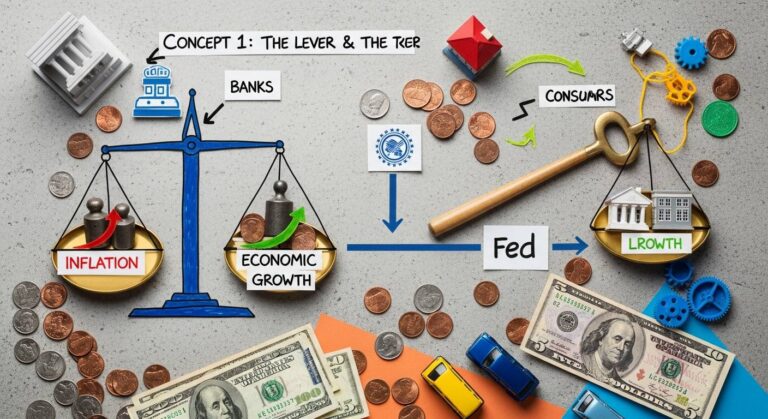
Changes in federal reserve interest rates are not just technical adjustments; they are powerful levers that can accelerate or decelerate the entire economy. Understanding this macroeconomic impact is essential to grasping the broader context of financial news and making informed personal decisions.
Influencing Inflation and Price Stability
One of the Fed’s core mandates is price stability, primarily controlling inflation. Here’s how interest rates play a role:
- When rates rise (monetary tightening): Higher interest rates increase the cost of borrowing for businesses and consumers. This can slow down spending and investment, reducing overall demand in the economy. With less demand, businesses are less likely to raise prices, which helps to cool inflationary pressures. Higher rates also make saving more attractive, pulling money out of circulation.
- When rates fall (monetary easing): Lower interest rates reduce the cost of borrowing, encouraging businesses to invest and expand, and consumers to spend (on homes, cars, etc.). This stimulates demand, which can lead to job growth. However, if demand grows too quickly, it can outstrip supply, leading to inflation.
The Fed’s challenge is to find the “sweet spot” where the economy grows robustly without overheating and generating excessive inflation.
Impact on Employment and Economic Growth
The other half of the Fed’s dual mandate is maximum employment. Interest rate policy directly influences job creation and overall economic output:
- Stimulating growth: When the economy is weak or in recession, the Fed typically lowers interest rates. This makes it cheaper for businesses to borrow money for expansion, hiring new employees, and investing in new equipment. Lower rates also encourage consumers to take out loans for major purchases, further boosting demand and economic activity, which translates into job growth.
- Slowing an overheated economy: Conversely, when the economy is growing too fast, leading to potential wage-price spirals and unsustainable inflation, the Fed raises rates. This makes borrowing more expensive, which can temper business expansion and consumer spending, slowing the pace of economic growth and potentially leading to slower job creation or even job losses in some sectors, as a necessary evil to bring inflation under control.
The relationship between interest rates, economic growth, and employment is a delicate balancing act, with the Fed constantly monitoring a wide array of economic indicators.
The U.S. Dollar and International Trade
Federal Reserve interest rate decisions also have significant international ramifications, particularly for the value of the U.S. dollar and international trade:
- Stronger dollar: Higher U.S. interest rates make dollar-denominated assets (like U.S. government bonds) more attractive to foreign investors seeking higher returns. This increased demand for dollars can strengthen the U.S. dollar relative to other currencies.
- Weaker dollar: Conversely, lower U.S. interest rates can make dollar assets less appealing, potentially leading to a weaker dollar.
A stronger dollar makes U.S. exports more expensive for foreign buyers, potentially reducing demand for American goods and services. At the same time, it makes imports cheaper for U.S. consumers, which can help mitigate domestic inflation but might hurt U.S. industries competing with imports. The reverse is true for a weaker dollar. These currency fluctuations have broad implications for multinational corporations, trade balances, and global economic stability.
Federal Reserve Interest Rates and Your Personal Finances: A Direct Connection
While the macroeconomic effects are broad, the impact of federal reserve interest rates on your personal finances is much more tangible and immediate. Every adjustment by the Fed can shift the ground beneath your savings, debts, and investments.
[INLINE IMAGE 2: place after fourth H2 | alt=”federal reserve interest rates comparison illustration”]
Borrowing Costs: Mortgages, Loans, and Credit Cards
This is perhaps the most direct and widely felt impact. Since the federal funds rate serves as a benchmark, changes in this rate directly influence the interest rates commercial banks offer to consumers and businesses.
- Mortgages:
- Fixed-rate mortgages: While not directly tied to the federal funds rate, they are influenced by broader market conditions, including the yield on U.S. Treasury bonds, which typically move in the same direction as the Fed’s policy rates. When the Fed raises rates, fixed mortgage rates generally follow suit. When the Fed cuts rates, fixed mortgage rates tend to fall, though often with a lag.
- Adjustable-rate mortgages (ARMs) and HELOCs: These are much more directly affected. ARMs and Home Equity Lines of Credit (HELOCs) are typically tied to an index like the prime rate (which moves with the federal funds rate) or LIBOR (though LIBOR is being phased out globally, with SOFR as a key replacement). When the Fed raises rates, the interest payments on these variable-rate products will likely increase, leading to higher monthly payments for borrowers.
- Auto Loans: Car loan rates, whether for new or used vehicles, also tend to rise and fall with the federal funds rate. Higher rates mean more expensive monthly payments and higher overall costs for purchasing a vehicle. This can dampen demand in the auto market.
- Personal Loans: Unsecured personal loans, used for debt consolidation, home improvements, or unexpected expenses, also become more expensive when the Fed raises rates.
- Credit Card Interest Rates: Most credit cards have variable interest rates that are directly tied to the prime rate. When the Fed raises its target rate, credit card APRs (Annual Percentage Rates) typically increase within one or two billing cycles. This means carrying a balance becomes more expensive, impacting household budgets significantly.
Savings and Investments: Opportunities and Challenges
While borrowers might lament rising rates, savers and investors often see new opportunities or challenges.
- Savings Accounts and Certificates of Deposit (CDs):
- Rising rates: When the Fed raises rates, banks typically increase the interest rates they offer on savings accounts, money market accounts, and CDs. This is beneficial for savers, as their money earns a higher return. This can be a significant advantage, especially for those with substantial emergency funds or short-term savings goals.
- Falling rates: Conversely, when the Fed cuts rates, the interest earned on these accounts generally falls, providing less incentive to save and potentially eroding purchasing power if inflation is present.
- Bonds: Bond prices and interest rates have an inverse relationship. When the Fed raises interest rates, newly issued bonds offer higher yields, making existing bonds with lower yields less attractive. This causes the market value of existing bonds to fall. For investors holding bonds, rising rates can lead to capital losses if they need to sell before maturity. For new bond investors, higher rates present an opportunity to lock in better yields.
- Stocks and Equity Markets: The relationship between interest rates and the stock market is more complex, but generally, rising interest rates can be a headwind for equities:
- Higher borrowing costs for companies: Businesses that rely on debt for expansion or operations face higher interest expenses, which can reduce their profitability.
- Discounting future earnings: Higher rates increase the discount rate used to value future corporate earnings. This makes future earnings less valuable in present terms, potentially leading to lower stock valuations.
- Alternative investments: Higher rates on “safe” assets like government bonds can make them more attractive relative to riskier stocks, potentially drawing some investment capital away from equities.
Falling rates generally have the opposite effect, often providing a tailwind for stock markets as borrowing becomes cheaper and future earnings are discounted less aggressively.
Comparison of Financial Product Sensitivity to Rate Changes
To illustrate the varying impact, consider this comparison:
| Financial Product | Impact of Rising Federal Reserve Rates | Impact of Falling Federal Reserve Rates | Example |
|---|---|---|---|
| Variable-Rate Mortgage/HELOC | Monthly payments likely increase as the underlying index rises. | Monthly payments likely decrease as the underlying index falls. | A HELOC tied to the prime rate will see its interest rate adjust directly. |
| Fixed-Rate Mortgage | New mortgages become more expensive (higher rates). Existing rates are locked in. | New mortgages become cheaper (lower rates). Existing rates are locked in. | Someone buying a home in a rising rate environment pays more interest. |
| Credit Card Debt | APR on outstanding balances increases, making debt more expensive to carry. | APR on outstanding balances decreases, making debt cheaper to carry. | A credit card with a 15% APR might jump to 18% if the Fed raises rates. |
| Savings Accounts/CDs | Yields offered by banks increase, meaning higher returns for savers. | Yields offered by banks decrease, meaning lower returns for savers. | A 1% savings account might become a 2.5% account with Fed rate hikes. |
| New Corporate Bonds | Issued with higher yields, more attractive for income investors. | Issued with lower yields, less attractive for income investors. | A company issuing new bonds offers 5% interest instead of 3%. |
| Existing Bonds (Market Value) | Market value decreases as new bonds offer higher yields. | Market value increases as existing higher yields become more valuable. | An investor holding a 3% bond sees its value fall if new bonds offer 5%. |
| Stock Market | Generally a headwind: higher borrowing costs, lower valuation multiples, more attractive alternatives. | Generally a tailwind: cheaper borrowing, potentially higher valuations, less attractive alternatives. | Technology stocks, often reliant on future growth, can be sensitive to rate changes. |
Understanding these direct connections is crucial for effectively managing your personal budget, debt, and investment portfolio in response to the Federal Reserve’s monetary policy decisions.
Historical Context and Trends in Federal Reserve Interest Rates
While we must adhere to specific year constraints, understanding the general patterns and drivers behind past Federal Reserve interest rate cycles offers valuable perspective. Historically, the Fed has navigated various economic challenges, from high inflation to deep recessions, by adjusting its benchmark rates.
Cycles of Tightening and Easing
The Federal Reserve’s interest rate policy typically moves in cycles, responding to prevailing economic conditions:
- Tightening Cycles (Rate Hikes): When the economy is growing robustly, and inflation risks emerge (e.g., due to strong demand outstripping supply, or wage pressures), the Fed typically enters a tightening cycle. This involves gradually raising the federal funds rate target to cool down the economy, prevent overheating, and bring inflation back to its 2% target. Such cycles are often characterized by strong job markets and rising consumer prices.
- Easing Cycles (Rate Cuts): When the economy faces headwinds, such as a slowdown in growth, rising unemployment, or a looming recession, the Fed typically enters an easing cycle. This involves lowering the federal funds rate target to stimulate borrowing, investment, and spending, thereby supporting economic activity and job creation. These cycles are often associated with economic weakness or periods of financial stress.
These cycles are not always smooth or predictable, and the Fed’s response can be influenced by unexpected global events, technological shifts, and changes in financial market dynamics.
Key Drivers Behind Rate Decisions
The FOMC’s decisions are never arbitrary; they are the result of careful analysis of a vast array of economic data points and forward-looking forecasts. The primary drivers include:
- Inflation Data: Measures like the Consumer Price Index (CPI) and Personal Consumption Expenditures (PCE) price index are paramount. If inflation is persistently above the 2% target, the Fed is likely to consider rate hikes. If inflation is consistently below target, it might consider rate cuts or holding rates low.
- Employment Statistics: The unemployment rate, non-farm payrolls, wage growth, and labor force participation rates provide insights into the health of the job market. Strong employment often allows the Fed more room to raise rates, while weakening employment might prompt a dovish stance.
- Economic Growth Indicators: Gross Domestic Product (GDP) reports, manufacturing indices, retail sales, and housing market data offer a broader picture of economic activity. Robust growth can support rate hikes, while slowing growth or contraction might necessitate easing.
- Global Economic Conditions: The U.S. economy does not operate in a vacuum. Global growth, geopolitical events, and the actions of other major central banks (like the European Central Bank or Bank of Japan) can influence the Fed’s decisions, particularly regarding trade and currency stability.
- Financial Market Stability: The Fed also considers the stability of the financial system. Extreme market volatility or stress can influence monetary policy, sometimes prompting pauses or adjustments to ensure financial conditions remain orderly.
The interplay of these factors is complex, and the Fed must often weigh competing signals, making its task challenging and its decisions highly scrutinized.
The “New Normal” in Monetary Policy
The 21st century has introduced unique challenges and responses for central banks globally. Periods of historically low interest rates following economic crises, coupled with the use of “unconventional” tools like quantitative easing (large-scale asset purchases), have reshaped the landscape of monetary policy. While such tools might not be constantly active, their existence and potential deployment mean the Fed has a broader toolkit to address future economic downturns or crises, going beyond simple rate adjustments. The Fed’s communication strategies have also evolved, with greater emphasis on transparency and forward guidance to help markets and the public anticipate future policy moves.
Forecasting Future Federal Reserve Interest Rates: What to Watch
Predicting the exact future path of federal reserve interest rates is a complex endeavor, even for seasoned economists. However, by understanding the key indicators and the Fed’s communication style, individuals can better anticipate potential shifts and prepare their personal finances.
Key Economic Indicators to Monitor
The Federal Reserve is a data-dependent institution. Its decisions are heavily influenced by the latest economic releases. To forecast potential rate changes, pay close attention to:
- Inflation Reports: Specifically, the Consumer Price Index (CPI) and the Personal Consumption Expenditures (PCE) price index (which is the Fed’s preferred measure). Look for trends in both headline and core inflation (excluding volatile food and energy prices). Persistent moves above or below the Fed’s 2% target are strong signals.
- Employment Reports: The monthly jobs report (non-farm payrolls, unemployment rate, wage growth) is crucial. Strong job growth and accelerating wages might signal a need for rate hikes, while weakening employment could suggest cuts.
- Gross Domestic Product (GDP) Releases: Quarterly GDP reports indicate the overall health and growth trajectory of the economy. Sustained strong growth often provides room for the Fed to tighten, while contraction or significant slowdowns can prompt easing.
- Retail Sales: A measure of consumer spending, which is a major component of GDP. Robust retail sales suggest strong consumer demand, potentially fueling inflation.
- Manufacturing and Services Indices: Surveys like the ISM Manufacturing and Services PMIs provide a snapshot of activity in key sectors. Readings above 50 generally indicate expansion, while below 50 suggest contraction.
- Housing Market Data: Home sales, housing starts, and building permits can indicate consumer confidence and broader economic health.
It’s not just the absolute numbers that matter, but also the trends and whether the data is coming in hotter or colder than market expectations.
The Federal Reserve’s Own Communications
The Fed is increasingly transparent about its intentions and outlook. Its communications are a primary source for forecasting:
- FOMC Statements: Released after each meeting, these statements provide the committee’s assessment of the economy and the rationale behind their rate decision. Pay attention to changes in language regarding inflation, employment, and future policy guidance.
- FOMC Press Conferences: The Fed Chair holds press conferences after every other FOMC meeting. These offer a deeper dive into the committee’s thinking and provide clues about future policy.
- “Dot Plot”: Published quarterly as part of the Summary of Economic Projections (SEP), the dot plot shows each FOMC member’s projection for the federal funds rate at the end of the current year, next year, and the longer run. While not a commitment, it indicates the general consensus and anticipated trajectory.
- Speeches by Fed Officials: Individual members of the Board of Governors and Federal Reserve Bank presidents frequently deliver speeches and participate in interviews, offering their personal views on the economy and monetary policy.
- Minutes of FOMC Meetings: Released three weeks after each meeting, these provide detailed insights into the discussions, disagreements, and nuances that led to the policy decision.
By carefully analyzing these communications, investors and consumers can gain a better understanding of the Fed’s “reaction function” and how it might respond to future economic developments.
Market Expectations and Tools
Financial markets themselves offer a powerful forecasting mechanism, as millions of participants bet on future rate movements:
- Fed Funds Futures: These financial derivatives allow traders to bet on the future level of the federal funds rate. Their prices reflect the market’s collective probability assigned to various rate outcomes at upcoming FOMC meetings.
- Bond Yields: Particularly the yield curve (the difference between short-term and long-term bond yields). An inverted yield curve (where short-term yields are higher than long-term yields) has historically been an indicator of an impending recession, often leading to Fed rate cuts.
While no forecast is perfect, a holistic approach that combines monitoring economic data, interpreting Fed communications, and understanding market sentiment offers the best chance to anticipate future federal reserve interest rates.
Strategies for Navigating Federal Reserve Interest Rate Changes
Given the profound impact of federal reserve interest rates on personal finance, proactively adapting your financial strategies to current and anticipated rate environments is a smart move. Whether rates are rising, falling, or holding steady, specific actions can help you optimize your financial health.
Strategies for a Rising Rate Environment
When the Fed is raising rates, the cost of borrowing increases, but returns on savings also tend to improve. This environment calls for a focus on debt management and capitalizing on higher yields:
- Prioritize Variable-Rate Debt: Focus intensely on paying down high-interest, variable-rate debt first, such as credit card balances, personal lines of credit, and adjustable-rate mortgages (ARMs) or HELOCs. As rates rise, the cost of carrying these debts will increase, potentially escalating your monthly payments.
- Refinance Fixed-Rate Debt: If you have a fixed-rate mortgage or loan that you took out when rates were significantly lower, consider if refinancing to another fixed rate is still beneficial. In a rising rate environment, securing a new fixed rate is generally less attractive, but if you have a very short time left on a high-rate loan, it might be worth exploring. More importantly, if you have a *variable-rate* loan, consider refinancing into a *fixed-rate* loan to lock in your payments before rates go higher.
- Capitalize on Higher Savings Yields: Move your emergency fund and other short-term savings into high-yield savings accounts, money market accounts, or short-term Certificates of Deposit (CDs). As banks compete for deposits, they will offer better rates. Laddering CDs (investing in CDs with staggered maturity dates) can be an effective strategy to capture rising rates while maintaining some liquidity.
- Review Investment Portfolio:
- Bonds: Be cautious with long-duration bonds, as their value tends to fall more significantly when rates rise. Consider shorter-duration bonds or bond funds that can reinvest at higher rates more quickly.
- Stocks: Companies with strong balance sheets, consistent cash flows, and less reliance on debt may perform better. Growth stocks, which rely on future earnings potential, can be more sensitive to rising rates due to higher discounting. Value stocks and dividend-paying stocks might offer more stability.
- Budgeting for Higher Loan Payments: If you have variable-rate debt, adjust your budget to accommodate potentially higher monthly payments. Factor in these increases to avoid financial strain.
Strategies for a Falling Rate Environment
When the Fed is cutting rates, borrowing becomes cheaper, but returns on traditional savings accounts typically decline. The focus here shifts to locking in lower borrowing costs and seeking alternative investments for yield:
- Refinance Fixed-Rate Debt: This is the prime time to consider refinancing existing fixed-rate mortgages, student loans, or personal loans to secure a lower interest rate, potentially saving tens of thousands of dollars over the life of the loan. Shop around for the best rates and consider the break-even point for closing costs.
- Consider Variable-Rate Debt (with caution): While fixed-rate is generally safer, if you anticipate paying off a loan quickly, a variable-rate loan might offer a lower initial interest rate in a falling rate environment. However, this strategy carries risk if rates unexpectedly reverse course.
- Review Investment Portfolio:
- Bonds: Existing bonds with higher yields become more attractive, and their market value may increase. Consider longer-duration bonds to lock in yields before they fall further.
- Stocks: Falling rates generally provide a tailwind for the stock market. Companies’ borrowing costs decrease, and future earnings are valued more highly. Growth stocks often benefit disproportionately.
- Re-evaluate Savings Strategies: With lower yields on savings accounts and CDs, you might need to reconsider where you park your cash if your primary goal is maximizing returns. However, never compromise your emergency fund’s liquidity or safety for higher (but riskier) returns. Some might explore dividend stocks or higher-yield corporate bonds if appropriate for their risk tolerance.
- Accelerate Large Purchases: If you’re planning a major purchase that requires financing (e.g., a car, home improvements), a falling rate environment can make it more affordable.
Strategies for a Stable Rate Environment
During periods of stable rates, the focus shifts to optimizing existing financial structures and strategic planning:
- Review and Consolidate Debt: With predictable interest costs, it’s an excellent time to consolidate high-interest debt into a lower-interest personal loan or balance transfer card if rates are still relatively low.
- Automate Savings and Investments: A stable environment allows for consistent, disciplined contributions to retirement accounts and investment portfolios without the immediate pressure of rapidly changing market conditions.
- Reassess Financial Goals: Use this period to review your long-term financial goals, such as retirement planning, college savings, or major purchases. Adjust your savings and investment strategies to align with these goals, knowing the interest rate landscape is relatively clear.
- Emergency Fund Check: Ensure your emergency fund is adequately stocked (3-6 months of living expenses) and in an accessible, low-risk account, regardless of the interest rate it earns.
Proactive financial planning based on the Federal Reserve’s likely interest rate path can significantly enhance your financial security and help you capitalize on economic trends. Stay informed, review your finances regularly, and adjust your strategies as needed.
The Global Perspective: How Federal Reserve Rates Resonate Worldwide
The Federal Reserve’s decisions regarding interest rates are not confined to the borders of the United States. Given the dollar’s status as the world’s primary reserve currency and the sheer size of the U.S. economy, changes in federal reserve interest rates send ripples across the global financial system, impacting economies, markets, and governments worldwide.
Impact on Global Capital Flows
One of the most immediate effects of Federal Reserve rate changes is on international capital flows:
- Higher U.S. Rates: When the Fed raises rates, U.S. assets (like Treasury bonds) become more attractive to international investors seeking higher returns. This can lead to capital flowing out of other countries and into the U.S. – often referred to as a “flight to safety” or “flight to yield.” This outflow can put pressure on other countries’ currencies and financial markets.
- Lower U.S. Rates: Conversely, when the Fed cuts rates, the attractiveness of U.S. assets diminishes. Capital may flow out of the U.S. and into other markets where returns are perceived to be better, potentially weakening the dollar and strengthening other currencies.
These capital movements can have significant implications for emerging market economies, which often rely on foreign investment to fund growth. A sudden withdrawal of capital can lead to currency depreciation, higher domestic interest rates, and financial instability.
Currency Exchange Rates and Trade
Changes in U.S. interest rates profoundly affect the value of the U.S. dollar against other currencies:
- Stronger Dollar: Higher U.S. rates generally lead to a stronger dollar. A strong dollar makes U.S. exports more expensive for foreign buyers, potentially reducing demand for American goods and services. It also makes imports into the U.S. cheaper, which can benefit American consumers but might hurt domestic industries that compete with imports.
- Weaker Dollar: Lower U.S. rates tend to weaken the dollar. A weaker dollar makes U.S. exports more competitive and imports more expensive. This can boost U.S. export-oriented industries but might contribute to inflation within the U.S. by increasing the cost of imported goods.
These currency shifts directly impact multinational corporations’ profitability, trade balances, and even global supply chains.
Monetary Policy Responses by Other Central Banks
Central banks around the world often find themselves in a challenging position when the Federal Reserve shifts its policy:
- Following the Fed: If the Fed raises rates, other central banks might feel compelled to raise their own rates to prevent capital outflows and stabilize their currencies. This is particularly true for central banks in emerging markets that are sensitive to dollar-denominated debt.
- Diverging from the Fed: Sometimes, central banks might choose to diverge from the Fed’s path if their domestic economic conditions warrant a different approach (e.g., if their economy is in recession while the U.S. is booming). However, this can lead to currency volatility and market pressure.
The coordination (or lack thereof) between the Fed and other major central banks like the European Central Bank (ECB) or the Bank of Japan (BOJ) is a critical factor in global financial stability.
Impact on Commodity Prices
Many global commodities, most notably oil, are priced in U.S. dollars. This means that changes in the dollar’s value, influenced by federal reserve interest rates, can affect commodity prices globally:
- Stronger Dollar: A stronger dollar makes dollar-denominated commodities more expensive for buyers holding other currencies. This can dampen demand and put downward pressure on commodity prices.
- Weaker Dollar: A weaker dollar makes dollar-denominated commodities cheaper for foreign buyers, potentially boosting demand and putting upward pressure on commodity prices.
This dynamic has significant implications for energy-importing nations, manufacturers, and consumers worldwide, impacting everything from fuel costs to food prices.
For more detailed information on commodity markets and their drivers, read our article on understanding commodity market fluctuations.
Myths vs. Realities: Common Misconceptions About Federal Reserve Interest Rates
Due to the complexity and far-reaching effects of Federal Reserve interest rates, several myths and misunderstandings often circulate. Separating fact from fiction is crucial for a clear understanding of monetary policy.
Myth 1: The Fed Directly Sets My Mortgage Rate
Reality: While the Federal Reserve’s actions profoundly influence mortgage rates, it does not directly set them. The federal funds rate target primarily impacts short-term borrowing costs for banks. Mortgage rates, especially fixed-rate mortgages, are more closely tied to the yield on longer-term U.S. Treasury bonds (like the 10-year Treasury note), which are influenced by a broader range of factors, including inflation expectations, investor demand, and the global economic outlook.
However, the two are related: if the Fed is aggressively hiking short-term rates to combat inflation, it often signals an expectation of stronger economic
Federal Reserve Interest Rates: Your Definitive Guide to Understanding Economic Shifts and Personal Impact
Affiliate disclosure: This article may contain affiliate links. Recommendations are independent and editorially driven.
The phrase “Federal Reserve interest rates” frequently appears in financial news, often accompanied by discussions of inflation, economic growth, and the cost of borrowing. For many, these discussions can feel abstract, shrouded in complex economic jargon. However, the decisions made by the Federal Reserve, particularly concerning interest rates, profoundly influence every aspect of personal finance, from the interest you earn on your savings to the cost of your mortgage, car loan, and even the performance of your investment portfolio. Understanding the Federal Reserve’s role, how it sets rates, and the far-reaching implications of those decisions is not just for economists and market analysts; it is critical knowledge for anyone managing their money in today’s dynamic economic landscape.
In this comprehensive guide, we will demystify the Federal Reserve’s interest rate policies. We’ll explore the mechanisms through which the Fed influences the broader economy, break down the real-world effects on your personal finances, and provide actionable insights to help you navigate periods of rate changes, whether rates are rising, falling, or holding steady. Our goal is to empower you with the knowledge needed to make informed financial decisions, understand market movements, and optimize your financial strategies in the context of the Federal Reserve’s ongoing influence.
What Are Federal Reserve Interest Rates? Defining the Benchmark of the Economy
At its core, the Federal Reserve (often called “the Fed”) is the central banking system of the United States. Its primary mandate, established by Congress, is to maintain maximum employment, stable prices (meaning low and stable inflation), and moderate long-term interest rates. To achieve these goals, the Fed employs a variety of tools, with influencing interest rates being among the most powerful and frequently discussed.
The Federal Funds Rate: The Linchpin of Monetary Policy
When financial news refers to “the Fed’s interest rate,” they are almost invariably talking about the federal funds rate. This isn’t an interest rate you or I directly pay or receive. Instead, it’s the target rate at which commercial banks lend their excess reserves to each other overnight to meet reserve requirements. While an interbank lending rate might seem distant from your daily life, its importance cannot be overstated. It serves as the foundational benchmark for virtually all other interest rates in the U.S. economy.
- How it works: Banks are required to hold a certain percentage of their deposits in reserve. If a bank has excess reserves, it can lend them to another bank that is short on reserves. The interest rate charged on these overnight loans is the federal funds rate.
- The Fed’s influence: The Fed doesn’t directly set this rate. Instead, it sets a target range for the federal funds rate and uses various tools, primarily open market operations (buying and selling government securities), to influence the supply of reserves in the banking system, thereby guiding the actual rate towards its target.
- Ripple effect: Changes in the federal funds rate ripple throughout the financial system, affecting the prime rate (which banks charge their most creditworthy customers), and subsequently influencing interest rates on consumer loans, mortgages, savings accounts, and business loans.
Key Components of the Fed’s Rate-Setting Structure
Beyond the federal funds rate, other rates and tools contribute to the Fed’s overall monetary policy framework:
- Interest on Reserve Balances (IORB): This is the interest rate the Fed pays to banks on the reserves they hold at the Fed. By adjusting the IORB, the Fed can encourage or discourage banks from lending their reserves, influencing the federal funds rate.
- Overnight Reverse Repurchase Agreement (ON RRP) Rate: This rate acts as a floor for short-term interest rates. The Fed conducts overnight reverse repos with a wide range of financial institutions, providing them a risk-free investment at the ON RRP rate. This ensures that the federal funds rate doesn’t fall too far below the Fed’s target.
- Discount Rate: This is the interest rate at which commercial banks can borrow money directly from the Federal Reserve through its “discount window.” It’s generally set higher than the federal funds rate and serves as a backstop source of liquidity for banks, often signaling the Fed’s stance on credit conditions.
Understanding these interconnected rates is crucial because they form the operational framework through which the Federal Reserve steers the broader economy, impacting everything from employment levels to the cost of consumer goods.
How the Federal Reserve Sets Interest Rates: The Mechanics of Monetary Policy
The process by which the Federal Reserve sets its target for the federal funds rate is deliberate, data-driven, and highly influential. It involves a dedicated committee, a set of clearly defined objectives, and a suite of monetary policy tools.
[INLINE IMAGE 1: place after second H2 | alt=”federal reserve interest rates concept illustration”]
The Federal Open Market Committee (FOMC)
The primary decision-making body for setting interest rates is the Federal Open Market Committee (FOMC). This committee consists of 12 members:
- Seven members of the Board of Governors of the Federal Reserve System.
- The President of the Federal Reserve Bank of New York.
- Presidents of four other Federal Reserve Banks on a rotating basis.
The FOMC meets eight times a year (approximately every six weeks) to assess the economic outlook and decide on the appropriate stance for monetary policy, including the target range for the federal funds rate. In addition to scheduled meetings, emergency meetings can be called if economic conditions warrant an immediate response.
The Dual Mandate: Guiding Principles for Rate Decisions
The FOMC’s decisions are primarily guided by its “dual mandate,” which requires it to pursue two overarching goals simultaneously:
- Maximum Employment: This doesn’t mean zero unemployment, which is unrealistic, but rather the highest level of employment the economy can sustain without generating excessive inflation. The Fed looks at various labor market indicators, including the unemployment rate, job growth, wage growth, and labor force participation.
- Price Stability: This means keeping inflation low and predictable. The Fed typically targets an annual inflation rate of 2% as measured by the Personal Consumption Expenditures (PCE) price index. A stable price environment allows businesses and consumers to plan for the future with greater certainty.
Striking the right balance between these two goals can be challenging. For example, policies aimed at stimulating employment might risk higher inflation, while efforts to curb inflation could slow economic growth and employment. The FOMC continuously analyzes incoming economic data and forecasts to determine the optimal path.
Tools of Monetary Policy
Once the FOMC decides on a target range for the federal funds rate, the Fed uses its tools to implement that decision. While open market operations used to be the primary tool, the current “ample reserves” framework relies more on administered rates:
- Interest on Reserve Balances (IORB): By adjusting the interest rate it pays banks on their reserves, the Fed can influence banks’ incentive to lend. Raising the IORB can encourage banks to hold more reserves, reducing the supply of funds available for interbank lending and pushing the federal funds rate up. Lowering it has the opposite effect.
- Overnight Reverse Repurchase Agreement (ON RRP) Facility: This facility allows financial institutions outside the traditional banking system to lend money to the Fed overnight, earning the ON RRP rate. This rate helps to set a floor for the federal funds rate, as banks would not lend to other banks at a rate lower than what they could get from the Fed.
- Discount Window Lending: While less frequently used for routine monetary policy, the discount window provides a backup source of liquidity for banks. Changes to the discount rate can signal the Fed’s stance on overall credit conditions.
- Open Market Operations (OMO): In the current ample reserves framework, OMOs (buying or selling government securities) are primarily used to maintain an ample supply of reserves in the banking system, ensuring that small fluctuations in reserve demand don’t unduly affect the federal funds rate. They can still be used for larger adjustments if needed.
The combination of these tools allows the Federal Reserve to effectively steer the federal funds rate towards its target, thereby influencing borrowing costs and economic activity throughout the nation.
For a deeper dive into how central banks operate globally, explore our insights on global monetary policy frameworks.
The Far-Reaching Impact of Federal Reserve Interest Rates on the Economy
Changes in federal reserve interest rates are not just technical adjustments; they are powerful levers that can accelerate or decelerate the entire economy. Understanding this macroeconomic impact is essential to grasping the broader context of financial news and making informed personal decisions.
Influencing Inflation and Price Stability
One of the Fed’s core mandates is price stability, primarily controlling inflation. Here’s how interest rates play a role:
- When rates rise (monetary tightening): Higher interest rates increase the cost of borrowing for businesses and consumers. This can slow down spending and investment, reducing overall demand in the economy. With less demand, businesses are less likely to raise prices, which helps to cool inflationary pressures. Higher rates also make saving more attractive, pulling money out of circulation.
- When rates fall (monetary easing): Lower interest rates reduce the cost of borrowing, encouraging businesses to invest and expand, and consumers to spend (on homes, cars, etc.). This stimulates demand, which can lead to job growth. However, if demand grows too quickly, it can outstrip supply, leading to inflation.
The Fed’s challenge is to find the “sweet spot” where the economy grows robustly without overheating and generating excessive inflation.
Impact on Employment and Economic Growth
The other half of the Fed’s dual mandate is maximum employment. Interest rate policy directly influences job creation and overall economic output:
- Stimulating growth: When the economy is weak or in recession, the Fed typically lowers interest rates. This makes it cheaper for businesses to borrow money for expansion, hiring new employees, and investing in new equipment. Lower rates also encourage consumers to take out loans for major purchases, further boosting demand and economic activity, which translates into job growth.
- Slowing an overheated economy: Conversely, when the economy is growing too fast, leading to potential wage-price spirals and unsustainable inflation, the Fed raises rates. This makes borrowing more expensive, which can temper business expansion and consumer spending, slowing the pace of economic growth and potentially leading to slower job creation or even job losses in some sectors, as a necessary evil to bring inflation under control.
The relationship between interest rates, economic growth, and employment is a delicate balancing act, with the Fed constantly monitoring a wide array of economic indicators.
The U.S. Dollar and International Trade
Federal Reserve interest rate decisions also have significant international ramifications, particularly for the value of the U.S. dollar and international trade:
- Stronger dollar: Higher U.S. interest rates make dollar-denominated assets (like U.S. government bonds) more attractive to foreign investors seeking higher returns. This increased demand for dollars can strengthen the U.S. dollar relative to other currencies.
- Weaker dollar: Conversely, lower U.S. interest rates can make dollar assets less appealing, potentially leading to a weaker dollar.
A stronger dollar makes U.S. exports more expensive for foreign buyers, potentially reducing demand for American goods and services. At the same time, it makes imports cheaper for U.S. consumers, which can help mitigate domestic inflation but might hurt U.S. industries competing with imports. The reverse is true for a weaker dollar. These currency fluctuations have broad implications for multinational corporations, trade balances, and global economic stability.
Federal Reserve Interest Rates and Your Personal Finances: A Direct Connection
While the macroeconomic effects are broad, the impact of federal reserve interest rates on your personal finances is much more tangible and immediate. Every adjustment by the Fed can shift the ground beneath your savings, debts, and investments.
[INLINE IMAGE 2: place after fourth H2 | alt=”federal reserve interest rates comparison illustration”]
Borrowing Costs: Mortgages, Loans, and Credit Cards
This is perhaps the most direct and widely felt impact. Since the federal funds rate serves as a benchmark, changes in this rate directly influence the interest rates commercial banks offer to consumers and businesses.
- Mortgages:
- Fixed-rate mortgages: While not directly tied to the federal funds rate, they are influenced by broader market conditions, including the yield on U.S. Treasury bonds, which typically move in the same direction as the Fed’s policy rates. When the Fed raises rates, fixed mortgage rates generally follow suit. When the Fed cuts rates, fixed mortgage rates tend to fall, though often with a lag.
- Adjustable-rate mortgages (ARMs) and HELOCs: These are much more directly affected. ARMs and Home Equity Lines of Credit (HELOCs) are typically tied to an index like the prime rate (which moves with the federal funds rate) or LIBOR (though LIBOR is being phased out globally, with SOFR as a key replacement). When the Fed raises rates, the interest payments on these variable-rate products will likely increase, leading to higher monthly payments for borrowers.
- Auto Loans: Car loan rates, whether for new or used vehicles, also tend to rise and fall with the federal funds rate. Higher rates mean more expensive monthly payments and higher overall costs for purchasing a vehicle. This can dampen demand in the auto market.
- Personal Loans: Unsecured personal loans, used for debt consolidation, home improvements, or unexpected expenses, also become more expensive when the Fed raises rates.
- Credit Card Interest Rates: Most credit cards have variable interest rates that are directly tied to the prime rate. When the Fed raises its target rate, credit card APRs (Annual Percentage Rates) typically increase within one or two billing cycles. This means carrying a balance becomes more expensive, impacting household budgets significantly.
Savings and Investments: Opportunities and Challenges
While borrowers might lament rising rates, savers and investors often see new opportunities or challenges.
- Savings Accounts and Certificates of Deposit (CDs):
- Rising rates: When the Fed raises rates, banks typically increase the interest rates they offer on savings accounts, money market accounts, and CDs. This is beneficial for savers, as their money earns a higher return. This can be a significant advantage, especially for those with substantial emergency funds or short-term savings goals.
- Falling rates: Conversely, when the Fed cuts rates, the interest earned on these accounts generally falls, providing less incentive to save and potentially eroding purchasing power if inflation is present.
- Bonds: Bond prices and interest rates have an inverse relationship. When the Fed raises interest rates, newly issued bonds offer higher yields, making existing bonds with lower yields less attractive. This causes the market value of existing bonds to fall. For investors holding bonds, rising rates can lead to capital losses if they need to sell before maturity. For new bond investors, higher rates present an opportunity to lock in better yields.
- Stocks and Equity Markets: The relationship between interest rates and the stock market is more complex, but generally, rising interest rates can be a headwind for equities:
- Higher borrowing costs for companies: Businesses that rely on debt for expansion or operations face higher interest expenses, which can reduce their profitability.
- Discounting future earnings: Higher rates increase the discount rate used to value future corporate earnings. This makes future earnings less valuable in present terms, potentially leading to lower stock valuations.
- Alternative investments: Higher rates on “safe” assets like government bonds can make them more attractive relative to riskier stocks, potentially drawing some investment capital away from equities.
Falling rates generally have the opposite effect, often providing a tailwind for stock markets as borrowing becomes cheaper and future earnings are discounted less aggressively.
Comparison of Financial Product Sensitivity to Rate Changes
To illustrate the varying impact, consider this comparison:
| Financial Product | Impact of Rising Federal Reserve Rates | Impact of Falling Federal Reserve Rates | Example |
|---|---|---|---|
| Variable-Rate Mortgage/HELOC | Monthly payments likely increase as the underlying index rises. | Monthly payments likely decrease as the underlying index falls. | A HELOC tied to the prime rate will see its interest rate adjust directly. |
| Fixed-Rate Mortgage | New mortgages become more expensive (higher rates). Existing rates are locked in. | New mortgages become cheaper (lower rates). Existing rates are locked in. | Someone buying a home in a rising rate environment pays more interest. |
| Credit Card Debt | APR on outstanding balances increases, making debt more expensive to carry. | APR on outstanding balances decreases, making debt cheaper to carry. | A credit card with a 15% APR might jump to 18% if the Fed raises rates. |
| Savings Accounts/CDs | Yields offered by banks increase, meaning higher returns for savers. | Yields offered by banks decrease, meaning lower returns for savers. | A 1% savings account might become a 2.5% account with Fed rate hikes. |
| New Corporate Bonds | Issued with higher yields, more attractive for income investors. | Issued with lower yields, less attractive for income investors. | A company issuing new bonds offers 5% interest instead of 3%. |
| Existing Bonds (Market Value) | Market value decreases as new bonds offer higher yields. | Market value increases as existing higher yields become more valuable. | An investor holding a 3% bond sees its value fall if new bonds offer 5%. |
| Stock Market | Generally a headwind: higher borrowing costs, lower valuation multiples, more attractive alternatives. | Generally a tailwind: cheaper borrowing, potentially higher valuations, less attractive alternatives. | Technology stocks, often reliant on future growth, can be sensitive to rate changes. |
Understanding these direct connections is crucial for effectively managing your personal budget, debt, and investment portfolio in response to the Federal Reserve’s monetary policy decisions.
Historical Context and Trends in Federal Reserve Interest Rates
While we must adhere to specific year constraints, understanding the general patterns and drivers behind past Federal Reserve interest rate cycles offers valuable perspective. Historically, the Fed has navigated various economic challenges, from high inflation to deep recessions, by adjusting its benchmark rates.
Cycles of Tightening and Easing
The Federal Reserve’s interest rate policy typically moves in cycles, responding to prevailing economic conditions:
- Tightening Cycles (Rate Hikes): When the economy is growing robustly, and inflation risks emerge (e.g., due to strong demand outstripping supply, or wage pressures), the Fed typically enters a tightening cycle. This involves gradually raising the federal funds rate target to cool down the economy, prevent overheating, and bring inflation back to its 2% target. Such cycles are often characterized by strong job markets and rising consumer prices.
- Easing Cycles (Rate Cuts): When the economy faces headwinds, such as a slowdown in growth, rising unemployment, or a looming recession, the Fed typically enters an easing cycle. This involves lowering the federal funds rate target to stimulate borrowing, investment, and spending, thereby supporting economic activity and job creation. These cycles are often associated with economic weakness or periods of financial stress.
These cycles are not always smooth or predictable, and the Fed’s response can be influenced by unexpected global events, technological shifts, and changes in financial market dynamics.
Key Drivers Behind Rate Decisions
The FOMC’s decisions are never arbitrary; they are the result of careful analysis of a vast array of economic data points and forward-looking forecasts. The primary drivers include:
- Inflation Data: Measures like the Consumer Price Index (CPI) and Personal Consumption Expenditures (PCE) price index are paramount. If inflation is persistently above the 2% target, the Fed is likely to consider rate hikes. If inflation is consistently below target, it might consider rate cuts or holding rates low.
- Employment Statistics: The unemployment rate, non-farm payrolls, wage growth, and labor force participation rates provide insights into the health of the job market. Strong employment often allows the Fed more room to raise rates, while weakening employment might prompt a dovish stance.
- Economic Growth Indicators: Gross Domestic Product (GDP) reports, manufacturing indices, retail sales, and housing market data offer a broader picture of economic activity. Robust growth can support rate hikes, while slowing growth or contraction might necessitate easing.
- Global Economic Conditions: The U.S. economy does not operate in a vacuum. Global growth, geopolitical events, and the actions of other major central banks (like the European Central Bank or Bank of Japan) can influence the Fed’s decisions, particularly regarding trade and currency stability.
- Financial Market Stability: The Fed also considers the stability of the financial system. Extreme market volatility or stress can influence monetary policy, sometimes prompting pauses or adjustments to ensure financial conditions remain orderly.
The interplay of these factors is complex, and the Fed must often weigh competing signals, making its task challenging and its decisions highly scrutinized.
The “New Normal” in Monetary Policy
The 21st century has introduced unique challenges and responses for central banks globally. Periods of historically low interest rates following economic crises, coupled with the use of “unconventional” tools like quantitative easing (large-scale asset purchases), have reshaped the landscape of monetary policy. While such tools might not be constantly active, their existence and potential deployment mean the Fed has a broader toolkit to address future economic downturns or crises, going beyond simple rate adjustments. The Fed’s communication strategies have also evolved, with greater emphasis on transparency and forward guidance to help markets and the public anticipate future policy moves.
Forecasting Future Federal Reserve Interest Rates: What to Watch
Predicting the exact future path of federal reserve interest rates is a complex endeavor, even for seasoned economists. However, by understanding the key indicators and the Fed’s communication style, individuals can better anticipate potential shifts and prepare their personal finances.
Key Economic Indicators to Monitor
The Federal Reserve is a data-dependent institution. Its decisions are heavily influenced by the latest economic releases. To forecast potential rate changes, pay close attention to:
- Inflation Reports: Specifically, the Consumer Price Index (CPI) and the Personal Consumption Expenditures (PCE) price index (which is the Fed’s preferred measure). Look for trends in both headline and core inflation (excluding volatile food and energy prices). Persistent moves above or below the Fed’s 2% target are strong signals.
- Employment Reports: The monthly jobs report (non-farm payrolls, unemployment rate, wage growth) is crucial. Strong job growth and accelerating wages might signal a need for rate hikes, while weakening employment could suggest cuts.
- Gross Domestic Product (GDP) Releases: Quarterly GDP reports indicate the overall health and growth trajectory of the economy. Sustained strong growth often provides room for the Fed to tighten, while contraction or significant slowdowns can prompt easing.
- Retail Sales: A measure of consumer spending, which is a major component of GDP. Robust retail sales suggest strong consumer demand, potentially fueling inflation.
- Manufacturing and Services Indices: Surveys like the ISM Manufacturing and Services PMIs provide a snapshot of activity in key sectors. Readings above 50 generally indicate expansion, while below 50 suggest contraction.
- Housing Market Data: Home sales, housing starts, and building permits can indicate consumer confidence and broader economic health.
It’s not just the absolute numbers that matter, but also the trends and whether the data is coming in hotter or colder than market expectations.
The Federal Reserve’s Own Communications
The Fed is increasingly transparent about its intentions and outlook. Its communications are a primary source for forecasting:
- FOMC Statements: Released after each meeting, these statements provide the committee’s assessment of the economy and the rationale behind their rate decision. Pay attention to changes in language regarding inflation, employment, and future policy guidance.
- FOMC Press Conferences: The Fed Chair holds press conferences after every other FOMC meeting. These offer a deeper dive into the committee’s thinking and provide clues about future policy.
- “Dot Plot”: Published quarterly as part of the Summary of Economic Projections (SEP), the dot plot shows each FOMC member’s projection for the federal funds rate at the end of the current year, next year, and the longer run. While not a commitment, it indicates the general consensus and anticipated trajectory.
- Speeches by Fed Officials: Individual members of the Board of Governors and Federal Reserve Bank presidents frequently deliver speeches and participate in interviews, offering their personal views on the economy and monetary policy.
- Minutes of FOMC Meetings: Released three weeks after each meeting, these provide detailed insights into the discussions, disagreements, and nuances that led to the policy decision.
By carefully analyzing these communications, investors and consumers can gain a better understanding of the Fed’s “reaction function” and how it might respond to future economic developments.
Market Expectations and Tools
Financial markets themselves offer a powerful forecasting mechanism, as millions of participants bet on future rate movements:
- Fed Funds Futures: These financial derivatives allow traders to bet on the future level of the federal funds rate. Their prices reflect the market’s collective probability assigned to various rate outcomes at upcoming FOMC meetings.
- Bond Yields: Particularly the yield curve (the difference between short-term and long-term bond yields). An inverted yield curve (where short-term yields are higher than long-term yields) has historically been an indicator of an impending recession, often leading to Fed rate cuts.
While no forecast is perfect, a holistic approach that combines monitoring economic data, interpreting Fed communications, and understanding market sentiment offers the best chance to anticipate future federal reserve interest rates.
Strategies for Navigating Federal Reserve Interest Rate Changes
Given the profound impact of federal reserve interest rates on personal finance, proactively adapting your financial strategies to current and anticipated rate environments is a smart move. Whether rates are rising, falling, or holding steady, specific actions can help you optimize your financial health.
Strategies for a Rising Rate Environment
When the Fed is raising rates, the cost of borrowing increases, but returns on savings also tend to improve. This environment calls for a focus on debt management and capitalizing on higher yields:
- Prioritize Variable-Rate Debt: Focus intensely on paying down high-interest, variable-rate debt first, such as credit card balances, personal lines of credit, and adjustable-rate mortgages (ARMs) or HELOCs. As rates rise, the cost of carrying these debts will increase, potentially escalating your monthly payments.
- Refinance Fixed-Rate Debt: If you have a fixed-rate mortgage or loan that you took out when rates were significantly lower, consider if refinancing to another fixed rate is still beneficial. In a rising rate environment, securing a new fixed rate is generally less attractive, but if you have a very short time left on a high-rate loan, it might be worth exploring. More importantly, if you have a *variable-rate* loan, consider refinancing into a *fixed-rate* loan to lock in your payments before rates go higher.
- Capitalize on Higher Savings Yields: Move your emergency fund and other short-term savings into high-yield savings accounts, money market accounts, or short-term Certificates of Deposit (CDs). As banks compete for deposits, they will offer better rates. Laddering CDs (investing in CDs with staggered maturity dates) can be an effective strategy to capture rising rates while maintaining some liquidity.
- Review Investment Portfolio:
- Bonds: Be cautious with long-duration bonds, as their value tends to fall more significantly when rates rise. Consider shorter-duration bonds or bond funds that can reinvest at higher rates more quickly.
- Stocks: Companies with strong balance sheets, consistent cash flows, and less reliance on debt may perform better. Growth stocks, which rely on future earnings potential, can be more sensitive to rising rates due to higher discounting. Value stocks and dividend-paying stocks might offer more stability.
- Budgeting for Higher Loan Payments: If you have variable-rate debt, adjust your budget to accommodate potentially higher monthly payments. Factor in these increases to avoid financial strain.
Strategies for a Falling Rate Environment
When the Fed is cutting rates, borrowing becomes cheaper, but returns on traditional savings accounts typically decline. The focus here shifts to locking in lower borrowing costs and seeking alternative investments for yield:
- Refinance Fixed-Rate Debt: This is the prime time to consider refinancing existing fixed-rate mortgages, student loans, or personal loans to secure a lower interest rate, potentially saving tens of thousands of dollars over the life of the loan. Shop around for the best rates and consider the break-even point for closing costs.
- Consider Variable-Rate Debt (with caution): While fixed-rate is generally safer, if you anticipate paying off a loan quickly, a variable-rate loan might offer a lower initial interest rate in a falling rate environment. However, this strategy carries risk if rates unexpectedly reverse course.
- Review Investment Portfolio:
- Bonds: Existing bonds with higher yields become more attractive, and their market value may increase. Consider longer-duration bonds to lock in yields before they fall further.
- Stocks: Falling rates generally provide a tailwind for the stock market. Companies’ borrowing costs decrease, and future earnings are valued more highly. Growth stocks often benefit disproportionately.
- Re-evaluate Savings Strategies: With lower yields on savings accounts and CDs, you might need to reconsider where you park your cash if your primary goal is maximizing returns. However, never compromise your emergency fund’s liquidity or safety for higher (but riskier) returns. Some might explore dividend stocks or higher-yield corporate bonds if appropriate for their risk tolerance.
- Accelerate Large Purchases: If you’re planning a major purchase that requires financing (e.g., a car, home improvements), a falling rate environment can make it more affordable.
Strategies for a Stable Rate Environment
During periods of stable rates, the focus shifts to optimizing existing financial structures and strategic planning:
- Review and Consolidate Debt: With predictable interest costs, it’s an excellent time to consolidate high-interest debt into a lower-interest personal loan or balance transfer card if rates are still relatively low.
- Automate Savings and Investments: A stable environment allows for consistent, disciplined contributions to retirement accounts and investment portfolios without the immediate pressure of rapidly changing market conditions.
- Reassess Financial Goals: Use this period to review your long-term financial goals, such as retirement planning, college savings, or major purchases. Adjust your savings and investment strategies to align with these goals, knowing the interest rate landscape is relatively clear.
- Emergency Fund Check: Ensure your emergency fund is adequately stocked (3-6 months of living expenses) and in an accessible, low-risk account, regardless of the interest rate it earns.
Proactive financial planning based on the Federal Reserve’s likely interest rate path can significantly enhance your financial security and help you capitalize on economic trends. Stay informed, review your finances regularly, and adjust your strategies as needed.
The Global Perspective: How Federal Reserve Rates Resonate Worldwide
The Federal Reserve’s decisions regarding interest rates are not confined to the borders of the United States. Given the dollar’s status as the world’s primary reserve currency and the sheer size of the U.S. economy, changes in federal reserve interest rates send ripples across the global financial system, impacting economies, markets, and governments worldwide.
Impact on Global Capital Flows
One of the most immediate effects of Federal Reserve rate changes is on international capital flows:
- Higher U.S. Rates: When the Fed raises rates, U.S. assets (like Treasury bonds) become more attractive to international investors seeking higher returns. This can lead to capital flowing out of other countries and into the U.S. – often referred to as a “flight to safety” or “flight to yield.” This outflow can put pressure on other countries’ currencies and financial markets.
- Lower U.S. Rates: Conversely, when the Fed cuts rates, the attractiveness of U.S. assets diminishes. Capital may flow out of the U.S. and into other markets where returns are perceived to be better, potentially weakening the dollar and strengthening other currencies.
These capital movements can have significant implications for emerging market economies, which often rely on foreign investment to fund growth. A sudden withdrawal of capital can lead to currency depreciation, higher domestic interest rates, and financial instability.
Currency Exchange Rates and Trade
Changes in U.S. interest rates profoundly affect the value of the U.S. dollar against other currencies:
- Stronger Dollar: Higher U.S. rates generally lead to a stronger dollar. A strong dollar makes U.S. exports more expensive for foreign buyers, potentially reducing demand for American goods and services. It also makes imports into the U.S. cheaper, which can benefit American consumers but might hurt domestic industries that compete with imports.
- Weaker Dollar: Lower U.S. rates tend to weaken the dollar. A weaker dollar makes U.S. exports more competitive and imports more expensive. This can boost U.S. export-oriented industries but might contribute to inflation within the U.S. by increasing the cost of imported goods.
These currency shifts directly impact multinational corporations’ profitability, trade balances, and even global supply chains.
Monetary Policy Responses by Other Central Banks
Central banks around the world often find themselves in a challenging position when the Federal Reserve shifts its policy:
- Following the Fed: If the Fed raises rates, other central banks might feel compelled to raise their own rates to prevent capital outflows and stabilize their currencies. This is particularly true for central banks in emerging markets that are sensitive to dollar-denominated debt.
- Diverging from the Fed: Sometimes, central banks might choose to diverge from the Fed’s path if their domestic economic conditions warrant a different approach (e.g., if their economy is in recession while the U.S. is booming). However, this can lead to currency volatility and market pressure.
The coordination (or lack thereof) between the Fed and other major central banks like the European Central Bank (ECB) or the Bank of Japan (BOJ) is a critical factor in global financial stability.
Impact on Commodity Prices
Many global commodities, most notably oil, are priced in U.S. dollars. This means that changes in the dollar’s value, influenced by federal reserve interest rates, can affect commodity prices globally:
- Stronger Dollar: A stronger dollar makes dollar-denominated commodities more expensive for buyers holding other currencies. This can dampen demand and put downward pressure on commodity prices.
- Weaker Dollar: A weaker dollar makes dollar-denominated commodities cheaper for foreign buyers, potentially boosting demand and putting upward pressure on commodity prices.
This dynamic has significant implications for energy-importing nations, manufacturers, and consumers worldwide, impacting everything from fuel costs to food prices.
For more detailed information on commodity markets and their drivers, read our article on understanding commodity market fluctuations.
Myths vs. Realities: Common Misconceptions About Federal Reserve Interest Rates
Due to the complexity and far-reaching effects of Federal Reserve interest rates, several myths and misunderstandings often circulate. Separating fact from fiction is crucial for a clear understanding of monetary policy.
Myth 1: The Fed Directly Sets My Mortgage Rate
Reality: While the Federal Reserve’s actions profoundly influence mortgage rates, it does not directly set them. The federal funds rate target primarily impacts short-term borrowing costs for banks. Mortgage rates, especially fixed-rate mortgages, are more closely tied to the yield on longer-term U.S. Treasury bonds (like the 10-year Treasury note), which are influenced by a broader range of factors, including inflation expectations, investor demand, and the global economic outlook.
However, the two are related: if the Fed is aggressively hiking short-term rates to combat inflation, it often signals an expectation of stronger economic