How Compound Interest Works: Unlocking the Ultimate Wealth-Building Engine
By diaalnews Editorial Team — Senior editors with 10+ years of subject-matter experience.
Published 2026-05-26 · Last Updated 2026-05-26
Affiliate disclosure: This article may contain affiliate links. Recommendations are independent and editorially driven.
In the vast and often complex world of personal finance, certain concepts stand out as foundational pillars. Among these, few possess the transformative power of compound interest. Often lauded as the “eighth wonder of the world” by Albert Einstein, understanding how compound interest works isn’t just an academic exercise; it’s a critical financial literacy skill that can dramatically reshape your financial future. Whether you’re saving for retirement, investing for growth, or even navigating debt, the principles of compounding are at play.
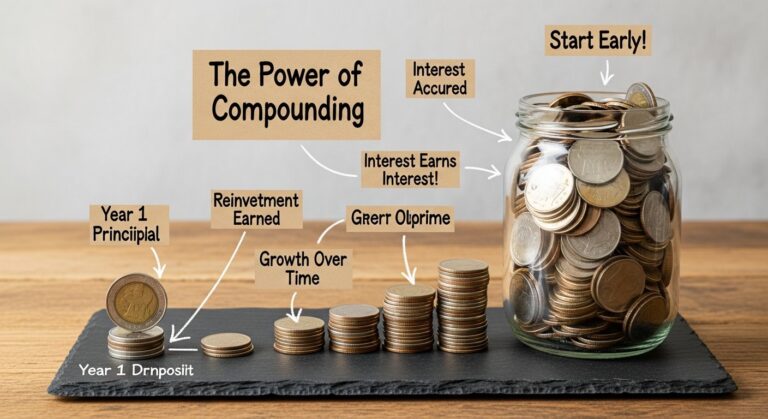
At its core, compound interest is the interest you earn not only on your initial principal but also on the accumulated interest from previous periods. This seemingly simple definition belies a profound mechanism that can accelerate wealth accumulation like nothing else. Imagine a snowball rolling down a hill: it starts small, but as it gathers more snow, it grows larger and faster, picking up even more snow with each rotation. Your money, fueled by compound interest, behaves much the same way, creating a powerful “snowball effect” that builds upon itself over time.
This comprehensive guide from diaalnews will demystify compound interest, breaking down its mechanics, illustrating its power with real-world examples, and providing actionable strategies to leverage it for your financial advantage. We’ll explore the difference between simple and compound interest, delve into the factors that influence its growth, and equip you with the knowledge to make informed financial decisions. By the time you finish reading, you’ll not only understand how compound interest works but also how to make it work tirelessly for you.
The Fundamental Principle: What Exactly is Compound Interest?
To truly grasp the magic of compound interest, we must first define it clearly. Compound interest is the interest on a loan or deposit calculated based on both the initial principal and the accumulated interest from previous periods. It’s “interest on interest.” This contrasts sharply with simple interest, which is calculated only on the principal amount.
Breaking Down the Core Concept
When you earn simple interest, let’s say on a savings account, you receive a fixed percentage of your original deposit. If you deposit $1,000 at a 5% simple interest rate, you’ll earn $50 each year, year after year, regardless of how much interest has accumulated. The principal remains the basis for calculation.
With compound interest, however, the landscape changes dramatically. In the first period, it might look similar to simple interest. But in the second period, the interest isn’t just calculated on your initial $1,000; it’s calculated on your $1,000 PLUS the $50 interest you earned in the first period, bringing your new principal to $1,050. This means you’ll earn 5% of $1,050, which is $52.50. This extra $2.50 might seem small, but over many periods, these seemingly minor additions compound into substantial sums.
The “Snowball Effect” Explained
The term “snowball effect” is frequently used to describe compound interest, and for good reason. Imagine a small snowball you start rolling down a fresh layer of snow. Initially, it grows slowly. But as it gathers more snow, its size increases, its surface area expands, and it picks up new snow at an ever-accelerating rate. Eventually, it can become a massive, unstoppable force.
Your money works the same way. The principal is your initial snowball. The interest it earns is the snow it gathers. As interest is added to the principal, the new, larger sum becomes the base for calculating the next period’s interest. This continuous growth, where earnings themselves earn more, is the very essence of compounding. It’s why starting early, even with small amounts, can lead to impressive wealth accumulation over time.
[INLINE IMAGE 1: place after second H2 | alt=”how compound interest works concept illustration”]
Beyond Simple: Differentiating Compound from Simple Interest
Understanding the distinction between simple and compound interest is fundamental to making sound financial decisions. While both involve earning (or paying) interest, their underlying mechanics lead to vastly different outcomes, especially over extended periods. Neglecting this difference can mean missing out on significant wealth-building opportunities or underestimating the true cost of debt.
Simple Interest: A Linear Growth Path
Simple interest is the most straightforward form of interest calculation. It is calculated solely on the original principal amount of a loan or deposit. The formula is quite basic: Simple Interest = Principal × Rate × Time.
- Principal (P): The initial amount of money borrowed or invested.
- Rate (R): The annual interest rate (expressed as a decimal).
- Time (T): The duration of the loan or investment in years.
For example, if you invest $1,000 at a simple interest rate of 5% per year for 10 years:
- Each year, you earn $1,000 × 0.05 = $50.
- Over 10 years, you earn $50 × 10 = $500 in total interest.
- Your total balance after 10 years would be $1,000 (principal) + $500 (interest) = $1,500.
The key takeaway here is that the interest earned each year is constant, always based on the initial $1,000. The growth is linear and predictable.
Compound Interest: Exponential Growth Unleashed
Compound interest, as we’ve established, is interest calculated on the initial principal AND on all the accumulated interest from previous periods. The formula is more complex than simple interest, but its impact is far greater: A = P(1 + r/n)^(nt), where:
- A: The future value of the investment/loan, including interest.
- P: The principal investment amount (the initial deposit or loan amount).
- r: The annual interest rate (as a decimal).
- n: The number of times that interest is compounded per year.
- t: The number of years the money is invested or borrowed for.
Using the same example: $1,000 invested at a 5% annual interest rate, compounded annually for 10 years:
- Year 1: $1,000 * 0.05 = $50. Balance = $1,050.
- Year 2: $1,050 * 0.05 = $52.50. Balance = $1,102.50.
- Year 3: $1,102.50 * 0.05 = $55.13. Balance = $1,157.63.
- …and so on.
By the end of 10 years, your total balance would be approximately $1,628.89. The total interest earned is $628.89. This is $128.89 more than with simple interest, all due to the power of compounding. The growth isn’t linear; it’s exponential, picking up speed as time progresses.
Practical Implications of the Difference
The choice between simple and compound interest (or recognizing which one applies) has significant practical implications:
- Savings Accounts and CDs: Most modern savings accounts, money market accounts, and Certificates of Deposit (CDs) offer compound interest, often compounded daily or monthly, which works to your advantage.
- Investments: Investments like stocks (through dividend reinvestment), bonds, and mutual funds inherently benefit from compounding, as earnings are often reinvested to generate further earnings.
- Loans: Car loans and mortgages typically use simple interest for their repayment schedules, but credit card debt is a notorious example of compound interest working against you, where interest is frequently compounded daily or monthly on your outstanding balance, rapidly inflating what you owe.
Understanding this fundamental difference empowers you to seek out compound interest opportunities when saving and investing, and to be wary of it when taking on debt.
The Mechanics of Growth: Step-by-Step Compounding Explained
While the formula for compound interest might appear intimidating, the underlying mechanics are quite intuitive once broken down. It’s all about how frequently and consistently interest is added to your principal, forming a new, larger base for subsequent interest calculations.
Step 1: Initial Investment (The Principal)
Every compounding journey begins with an initial principal amount. This could be the money you deposit into a savings account, the capital you invest in a stock, or the initial sum of a loan you take out. Let’s assume you start with $5,000.
Step 2: The Interest Rate
Next, there’s an annual interest rate, expressed as a percentage. This rate determines how much interest is earned (or charged) on the principal over a year. For our example, let’s use an annual rate of 7%.
Step 3: Compounding Frequency
This is where compound interest truly diverges from simple interest. Compounding frequency refers to how often the interest is calculated and added back to the principal. Common frequencies include:
- Annually (n=1): Once per year.
- Semi-annually (n=2): Twice per year (every six months).
- Quarterly (n=4): Four times per year (every three months).
- Monthly (n=12): Twelve times per year.
- Daily (n=365): Every day.
The more frequently interest is compounded, the faster your money grows, because the interest starts earning interest sooner. For our example, let’s assume monthly compounding.
Step 4: Calculating Interest for the First Period
At the end of the first compounding period (in our case, one month), the interest is calculated on the initial principal. The annual rate needs to be divided by the number of compounding periods per year. So, for a 7% annual rate compounded monthly, the monthly rate is 7% / 12 = 0.07 / 12 ≈ 0.005833.
- Interest for Month 1 = Principal × (Annual Rate / Compounding Frequency)
- Interest for Month 1 = $5,000 × (0.07 / 12) = $5,000 × 0.005833 = $29.17
Step 5: Adding Interest to the Principal (Reinvestment)
Now, this earned interest is added to the original principal. This forms a new, larger principal for the next period’s calculation. This step is the “compound” in compound interest.
- New Principal for Month 2 = Original Principal + Interest for Month 1
- New Principal for Month 2 = $5,000 + $29.17 = $5,029.17
Step 6: Repeat the Process (The Snowball Grows)
For the second compounding period (Month 2), the interest is now calculated on this new, larger principal ($5,029.17).
- Interest for Month 2 = $5,029.17 × (0.07 / 12) = $29.34
Notice that the interest earned in Month 2 ($29.34) is slightly more than the interest earned in Month 1 ($29.17), even though the rate remained the same. This difference is the “interest on interest.” This process continues for every subsequent compounding period. Each time, the base for the interest calculation grows larger, leading to an accelerating rate of wealth accumulation.
Over a year, with monthly compounding, your initial $5,000 at 7% would grow to approximately $5,362.48. If it were simple interest, it would only be $5,350. The difference might seem minor in a single year, but extend this over decades, and the gap becomes astronomical.
Learn more about investment growth strategies.
The Time-Value Nexus: Why Early Start and Longevity are Key
While interest rates and compounding frequency play crucial roles, the single most powerful ingredient in the compound interest equation is time. The longer your money has to grow, the more pronounced the “snowball effect” becomes. This undeniable truth underscores the immense financial advantage of starting early and maintaining a long-term perspective in your savings and investments.
The Rule of 72: A Quick Estimator for Doubling Your Money
To appreciate the power of time, one handy mental shortcut is the “Rule of 72.” This simple formula allows you to estimate how long it will take for an investment to double in value, given a fixed annual rate of return. It’s calculated as:
- Years to Double = 72 / Annual Interest Rate (as a whole number)
For example:
- If you earn 6% annually, your money will double in approximately 72 / 6 = 12 years.
- If you earn 8% annually, your money will double in approximately 72 / 8 = 9 years.
- If you earn 12% annually, your money will double in approximately 72 / 12 = 6 years.
The Rule of 72 clearly illustrates that even a modest increase in your return rate can significantly shorten the time it takes for your wealth to multiply. But more importantly, it highlights how multiple doubling periods can quickly turn a small sum into a large one.
The Cost of Delay: A Tale of Two Investors
Consider two hypothetical investors, Sarah and Tom, both aiming for a comfortable retirement. Both earn an average annual return of 8% on their investments.
- Sarah: Starts investing $200 per month at age 25. She continues for 10 years, contributing a total of $24,000, then stops contributing entirely but leaves her money invested.
- Tom: Waits until age 35 to start investing $200 per month. He contributes consistently for 30 years until age 65, contributing a total of $72,000.
Who ends up with more money by age 65?
Surprisingly, Sarah, who only contributed for 10 years and invested a third of what Tom did, likely ends up with significantly more money. This is because her initial contributions had an extra decade of compounding. Her money started earning interest on interest much earlier, giving it a powerful head start.
This common scenario powerfully demonstrates the concept of “opportunity cost” when it comes to time and investing. The interest earned in the early years has the longest runway to compound, leading to a disproportionately larger impact on final wealth.
Longevity and Consistency: The Unsung Heroes
Beyond just starting early, the consistency of your contributions and the sheer duration of your investment horizon are equally vital. Small, regular contributions made over many years, even decades, can outpace larger, inconsistent investments made over shorter periods.
- Regular Contributions: By consistently adding to your principal, you’re not only investing new money but also increasing the base upon which interest is calculated. This supercharges the compounding effect.
- Long-Term Horizon: Market fluctuations are inevitable. However, a long-term perspective allows you to ride out downturns and benefit from the market’s historical upward trend. The longer your money is invested, the more time it has to recover from dips and continue its exponential growth path.
The message is clear: when it comes to harnessing compound interest, time is your most valuable asset. The earlier you start, and the longer you stay invested, the more potent the force of compounding becomes in building your wealth.
[INLINE IMAGE 2: place after fourth H2 | alt=”how compound interest works comparison illustration”]
Key Variables: Factors That Fuel (or Hinder) Compound Growth
While time is arguably the most critical factor, several other variables significantly influence the pace and extent of compound growth. Understanding these elements empowers you to optimize your financial strategies, whether you’re saving, investing, or managing debt.
1. The Interest Rate (Rate of Return)
The interest rate, often expressed as an Annual Percentage Yield (APY) for savings or an expected annual return for investments, directly dictates how quickly your money grows. A higher interest rate means a larger percentage of your principal (and accumulated interest) is added each compounding period, accelerating the snowball effect.
- Savings Accounts: Look for accounts with competitive APYs. Even a difference of 0.5% or 1% can translate into thousands of dollars over decades.
- Investments: Different investment vehicles carry different expected rates of return (e.g., bonds typically offer lower returns than stocks but with less volatility). Your asset allocation strategy will significantly impact your overall average rate of return.
- Debt: Conversely, a higher interest rate on debt means interest accrues faster, making it more expensive and harder to pay off.
2. Compounding Frequency
As discussed in the mechanics section, compounding frequency refers to how often the interest is calculated and added back to the principal. The more frequently interest is compounded, the faster your money grows. This is because interest begins to earn interest sooner.
- Daily Compounding: Offers the highest growth for savers and investors.
- Monthly Compounding: Very common for savings accounts, CDs, and often for credit card debt (which works against you).
- Quarterly, Semi-annually, Annually: Less frequent compounding results in slower growth compared to daily or monthly, but still vastly superior to simple interest over time.
When comparing financial products, always look for the APY (Annual Percentage Yield) rather than just the stated interest rate. The APY accounts for the effect of compounding frequency and provides a more accurate representation of the actual return you’ll receive over a year.
3. Initial Principal Amount
It stands to reason that the more money you start with, the more interest you will earn in absolute terms. A larger initial principal provides a bigger base for the compounding process to begin, leading to larger interest payouts from day one.
- While starting with a small amount is better than not starting at all, increasing your initial investment (if feasible) can significantly jumpstart your compounding journey.
- This also applies to debt: a larger initial loan principal means more interest accrues, making the total repayment amount higher.
4. Additional Contributions (or Payments)
Regularly adding to your principal is a powerful accelerant for compound growth. Each new contribution immediately becomes part of the principal, instantly expanding the base upon which future interest is calculated. This is why consistent saving and investing are so effective.
- Dollar-Cost Averaging: Investing a fixed amount regularly, regardless of market fluctuations, can smooth out your purchase price and further enhance compound returns over time.
- Debt Repayment: On the flip side, making extra payments on a compound interest loan (like a credit card) directly reduces the principal, thereby reducing the amount on which interest is calculated, saving you money and accelerating debt payoff.
5. Taxes and Fees
While not directly part of the compounding formula, taxes and fees are crucial external factors that can erode your compound returns. Investment fees (management fees, trading fees) and capital gains taxes or income taxes on interest earned can reduce the net amount available to compound.
- Tax-Advantaged Accounts: Utilizing accounts like 401(k)s, IRAs (Traditional or Roth), and HSAs allows your investments to grow tax-deferred or tax-free, significantly enhancing the compounding effect by preventing taxes from eating into your earnings year after year.
- Low-Cost Investments: Opting for index funds or ETFs with low expense ratios minimizes the drag of fees on your returns.
Understanding and strategically managing these variables allows you to fine-tune your financial approach, ensuring that compound interest works as efficiently and powerfully as possible for your goals.
Explore tax-advantaged retirement accounts.
Compound Interest in Action: Real-World Applications Across Finance
The principles of compound interest are not confined to theoretical discussions; they are woven into the fabric of nearly every financial product and service we encounter. Recognizing where and how compound interest operates is key to leveraging its benefits and mitigating its drawbacks.
1. Savings Accounts and Certificates of Deposit (CDs)
This is perhaps the most straightforward application of compound interest for most individuals. When you deposit money into a savings account or purchase a CD, the bank pays you interest. This interest is typically compounded daily or monthly and then added to your principal, leading to a higher balance for the next interest calculation. This is why the APY (Annual Percentage Yield) for these accounts will always be slightly higher than the stated annual interest rate, as it reflects the effect of compounding.
2. Retirement Accounts (401(k)s, IRAs, etc.)
Retirement savings vehicles are prime examples of where compound interest truly shines over the long term. Contributions to 401(k)s and IRAs are invested in various assets (stocks, bonds, mutual funds) that generate returns. These returns, if reinvested, compound over decades, often tax-deferred or tax-free (in the case of Roth accounts). The power of tax-advantaged compounding is a cornerstone of effective retirement planning.
3. Stock Market Investments (Dividends and Capital Gains)
- Dividend Reinvestment: Many companies pay dividends to shareholders. If you choose to reinvest these dividends, you use them to buy more shares of the company. These new shares then earn their own dividends and potentially appreciate in value, creating a powerful compounding loop.
- Capital Gains Reinvestment: For growth stocks, the value of your shares increases over time (capital gains). While not directly “interest,” if you sell some shares and reinvest the proceeds into other growing assets, you are effectively compounding your capital. Mutual funds and ETFs often reinvest any capital gains they realize, compounding within the fund itself.
4. Bonds and Mutual Funds
Bonds typically pay interest (coupons) to bondholders. If you reinvest these coupon payments, they start earning their own interest, leading to compound growth. Mutual funds, particularly those that are accumulation funds or where you opt for dividend and capital gains reinvestment, are designed to harness compounding internally, as all earnings are automatically put back into the fund to buy more units, growing your investment base.
5. Real Estate Investments
While not always thought of in terms of “interest,” real estate can exhibit a powerful compounding effect. Property values tend to appreciate over time. If you use rental income to pay down your mortgage faster or reinvest it into property improvements, you’re accelerating your equity growth and increasing the asset’s value, which then continues to appreciate on its new, higher base.
6. Loan Repayments (Working Against You)
Compound interest isn’t always your friend. It works powerfully against you when you borrow money, especially with high-interest debt:
- Credit Cards: This is the most infamous example. Credit card interest is often compounded daily or monthly. If you carry a balance, the interest from one period is added to your principal, and then the next period’s interest is calculated on that new, higher balance. This can quickly lead to an overwhelming debt spiral if not managed carefully.
- Personal Loans and Mortgages: While these typically have simple interest payment structures (meaning your interest is calculated on the remaining principal balance, and fixed payments cover a portion of principal and interest), late payment fees or deferred interest scenarios can introduce compounding elements that increase the total cost.
- Student Loans: Many student loans accrue interest while you’re in school. If you don’t pay this interest, it can be capitalized (added to your principal balance) when repayment begins, leading to a larger principal and, thus, more interest charged over the life of the loan.
Understanding these diverse applications underscores the omnipresence of compound interest. By recognizing its presence, you can strategically align your financial behaviors to maximize its benefits and minimize its potential to hinder your financial progress.
Strategies to Supercharge Your Compound Returns
Knowing how compound interest works is one thing; actively harnessing its power to build wealth is another. By implementing strategic approaches, you can significantly amplify the compounding effect on your savings and investments.
1. Start Early, Even with Small Amounts
As the “Time-Value Nexus” section highlighted, time is the ultimate accelerator for compound interest. The earliest contributions have the longest runway to grow. Don’t fall into the trap of waiting until you have a “large” sum to invest. Even $50 or $100 a month, started in your 20s, can outpace much larger contributions made in your 30s or 40s due to the magic of early compounding.
- Action: Open a retirement account (401(k), IRA) or a brokerage account as soon as possible. Set up automated, recurring investments, no matter how modest they seem initially.
2. Prioritize Consistent, Regular Contributions
Beyond the initial deposit, consistent contributions are critical. Each new dollar you add becomes part of the principal and immediately begins earning interest. This dramatically increases the base upon which interest is calculated, amplifying your returns over time.
- Action: Automate your savings and investments. Set up direct deposits from your paycheck into your savings or investment accounts. Treat these contributions as non-negotiable expenses.
3. Maximize Your Interest Rate (or Rate of Return)
A higher interest rate means faster growth. While you can’t control market returns, you can make informed choices about where you park your money.
- For Savings: Shop around for high-yield savings accounts and competitive CD rates. Don’t let your money languish in a low-interest account.
- For Investments: Choose investments that align with your risk tolerance and financial goals, aiming for a reasonable long-term rate of return. Diversify your portfolio to manage risk while still seeking growth.
- Action: Periodically review your savings accounts and investment performance. Consider rebalancing your portfolio to maintain your desired risk/return profile.
4. Leverage Tax-Advantaged Accounts
Taxes are a drag on compound returns. Every dollar paid in taxes is a dollar that can’t compound. Tax-advantaged accounts protect your investment growth from immediate taxation, allowing your money to grow larger before taxes are potentially owed.
- 401(k)s and IRAs (Traditional): Contributions are often tax-deductible, and growth is tax-deferred until retirement.
- Roth 401(k)s and Roth IRAs: Contributions are made with after-tax dollars, but qualified withdrawals in retirement are completely tax-free. This means all your compounded gains are yours to keep, tax-free.
- Health Savings Accounts (HSAs): Offer a triple tax advantage – tax-deductible contributions, tax-free growth, and tax-free withdrawals for qualified medical expenses.
These accounts supercharge compounding by allowing 100% of your earnings to remain invested and grow, rather than a portion being siphoned off by taxes each year.
| Account Type | Key Benefit | Tax Advantages | Ideal For |
|---|---|---|---|
| Traditional 401(k) | Employer-sponsored, often with matching contributions. | Pre-tax contributions, tax-deferred growth. Withdrawals taxed in retirement. | Individuals expecting to be in a lower tax bracket in retirement. |
| Roth 401(k) | Employer-sponsored, tax-free withdrawals in retirement. | After-tax contributions, tax-free growth, tax-free qualified withdrawals. | Individuals expecting to be in a higher tax bracket in retirement. |
| Traditional IRA | Individual retirement account, often tax-deductible contributions. | Pre-tax (if eligible) contributions, tax-deferred growth. Withdrawals taxed in retirement. | Self-employed, individuals without employer plans, or those seeking tax deduction. |
| Roth IRA | Individual retirement account, tax-free withdrawals in retirement. | After-tax contributions, tax-free growth, tax-free qualified withdrawals. | Individuals expecting higher future tax rates, no RMDs for original owner. |
| Health Savings Account (HSA) | Triple tax advantage for those with high-deductible health plans. | Tax-deductible contributions, tax-free growth, tax-free withdrawals for medical expenses. | Individuals with HDHPs, seeking a flexible savings and investment vehicle. |
5. Reinvest All Dividends and Capital Gains
Whenever your investments generate income (dividends from stocks, interest from bonds, capital gains from mutual funds), ensure these earnings are reinvested back into the original investment. This directly fuels the compounding process, turning those earnings into new principal that can generate its own returns. Many brokerage accounts allow you to set up automatic dividend reinvestment.
- Action: Check your investment accounts and set preferences to “reinvest dividends” and “reinvest capital gains.”
6. Minimize Fees and Expenses
Fees, much like taxes, are a drag on your returns. High expense ratios in mutual funds, frequent trading commissions, or excessive advisor fees can significantly diminish the amount available for compounding over the long run. Even a 1% difference in annual fees can cost you tens or hundreds of thousands of dollars over a 30-year investment horizon.
- Action: Choose low-cost index funds, ETFs, and robo-advisors. Be mindful of trading costs and only pay for financial advice that genuinely adds value.
7. Understand and Manage Inflation
While your money is compounding, inflation is simultaneously eroding its purchasing power. To truly grow your wealth, your nominal return (the stated interest rate) must exceed the inflation rate. This is why investing for growth is crucial, as simply keeping money in a low-interest savings account may see its purchasing power diminish over time, even with compounding.
- Action: Diversify your portfolio with assets that historically outpace inflation, such as stocks and real estate.
By consistently applying these strategies, you can transform the theoretical understanding of compound interest into tangible, accelerating wealth growth, setting yourself on a firm path toward achieving your financial goals.
The Double-Edged Sword: Compound Interest and Debt
Up to this point, we’ve primarily explored compound interest from the perspective of an investor or saver, where it acts as a powerful ally. However, the exact same mechanism can work devastatingly against you when you’re on the borrowing side, especially with high-interest debt. Understanding this “double-edged sword” is critical for maintaining financial health and avoiding common pitfalls.
When Compound Interest Becomes a Foe: High-Interest Debt
The most notorious example of compound interest working against you is high-interest consumer debt, particularly credit card balances. Here’s why it’s so problematic:
- Frequent Compounding: Credit card interest is typically compounded daily or monthly. This means that at the end of each day or month, any unpaid interest is added to your principal balance, and the next day/month’s interest is calculated on this new, larger amount.
- High Annual Percentage Rates (APRs): Credit cards often carry APRs ranging from 15% to 25% or even higher. When these high rates are compounded frequently, the amount you owe can snowball rapidly, making it incredibly difficult to pay off the principal.
- Minimum Payments Trap: Credit card minimum payments are often designed to barely cover the monthly interest, leaving very little to reduce the principal. This means you could be making payments for years, yet your balance barely shrinks, while the bank continues to earn compound interest on your ever-growing debt.
Consider a $5,000 credit card balance at an 18% APR, compounded monthly. If you only make the minimum payment (say, 2% of the balance), it could take you over a decade to pay it off, and you might end up paying more than double the original $5,000 in interest alone.
Student Loans and Interest Capitalization
Many student loans accrue interest while you are still in school or during periods of deferment/forbearance. If this accrued interest is not paid, it can be “capitalized” – meaning it’s added to your principal balance. Once capitalized, this larger principal then begins to accrue interest, which is essentially compounding. This increases your total loan amount and the total interest you’ll pay over the life of the loan.
Strategies to Combat Compound Interest on Debt
Just as there are strategies to harness compound interest for wealth, there are equally important strategies to mitigate its negative effects on debt:
- Pay More Than the Minimum: This is the single most effective strategy for high-interest, compounding debt. Any extra payment above the minimum directly reduces your principal, immediately shrinking the base upon which future interest is calculated. This creates a reverse compounding effect, where less interest accrues, allowing more of your payment to go towards the principal, further accelerating payoff.
- Prioritize High-Interest Debt (Debt Snowball/Avalanche):
- Debt Avalanche: Focus on paying off debts with the highest interest rates first, while making minimum payments on others. This saves you the most money on interest due to compound effects.
- Debt Snowball: Focus on paying off the smallest debt first to gain psychological momentum, then move to the next smallest. While not mathematically the most efficient, the motivational boost can be very powerful.
- Consolidate or Refinance: For high-interest debts, consolidating them into a single loan with a lower interest rate can significantly reduce the total interest paid and simplify your payments. Refinancing student loans or mortgages at lower rates can also save you substantial amounts over the loan term. Be cautious of fees and new terms when considering these options.
- Avoid New Debt: The simplest way to avoid compound interest working against you is to not incur high-interest debt in the first place. Live within your means and build an emergency fund to cover unexpected expenses, reducing reliance on credit cards.
- Understand Loan Terms: Before taking out any loan, especially personal loans or mortgages, thoroughly
How Compound Interest Works: Unlocking the Ultimate Wealth-Building Engine
By diaalnews Editorial Team — Senior editors with 10+ years of subject-matter experience.
Published 2026-05-26 · Last Updated 2026-05-26Affiliate disclosure: This article may contain affiliate links. Recommendations are independent and editorially driven.
In the vast and often complex world of personal finance, certain concepts stand out as foundational pillars. Among these, few possess the transformative power of compound interest. Often lauded as the “eighth wonder of the world” by Albert Einstein, understanding how compound interest works isn’t just an academic exercise; it’s a critical financial literacy skill that can dramatically reshape your financial future. Whether you’re saving for retirement, investing for growth, or even navigating debt, the principles of compounding are at play.
At its core, compound interest is the interest you earn not only on your initial principal but also on the accumulated interest from previous periods. This seemingly simple definition belies a profound mechanism that can accelerate wealth accumulation like nothing else. Imagine a snowball rolling down a hill: it starts small, but as it gathers more snow, it grows larger and faster, picking up even more snow with each rotation. Your money, fueled by compound interest, behaves much the same way, creating a powerful “snowball effect” that builds upon itself over time.
This comprehensive guide from diaalnews will demystify compound interest, breaking down its mechanics, illustrating its power with real-world examples, and providing actionable strategies to leverage it for your financial advantage. We’ll explore the difference between simple and compound interest, delve into the factors that influence its growth, and equip you with the knowledge to make informed financial decisions. By the time you finish reading, you’ll not only understand how compound interest works but also how to make it work tirelessly for you.
The Fundamental Principle: What Exactly is Compound Interest?
To truly grasp the magic of compound interest, we must first define it clearly. Compound interest is the interest on a loan or deposit calculated based on both the initial principal and the accumulated interest from previous periods. It’s “interest on interest.” This contrasts sharply with simple interest, which is calculated only on the principal amount.
Breaking Down the Core Concept
When you earn simple interest, let’s say on a savings account, you receive a fixed percentage of your original deposit. If you deposit $1,000 at a 5% simple interest rate, you’ll earn $50 each year, year after year, regardless of how much interest has accumulated. The principal remains the basis for calculation.
With compound interest, however, the landscape changes dramatically. In the first period, it might look similar to simple interest. But in the second period, the interest isn’t just calculated on your initial $1,000; it’s calculated on your $1,000 PLUS the $50 interest you earned in the first period, bringing your new principal to $1,050. This means you’ll earn 5% of $1,050, which is $52.50. This extra $2.50 might seem small, but over many periods, these seemingly minor additions compound into substantial sums.
The “Snowball Effect” Explained
The term “snowball effect” is frequently used to describe compound interest, and for good reason. Imagine a small snowball you start rolling down a fresh layer of snow. Initially, it grows slowly. But as it gathers more snow, its size increases, its surface area expands, and it picks up new snow at an ever-accelerating rate. Eventually, it can become a massive, unstoppable force.
Your money works the same way. The principal is your initial snowball. The interest it earns is the snow it gathers. As interest is added to the principal, the new, larger sum becomes the base for calculating the next period’s interest. This continuous growth, where earnings themselves earn more, is the very essence of compounding. It’s why starting early, even with small amounts, can lead to impressive wealth accumulation over time.
[INLINE IMAGE 1: place after second H2 | alt=”how compound interest works concept illustration”]
Beyond Simple: Differentiating Compound from Simple Interest
Understanding the distinction between simple and compound interest is fundamental to making sound financial decisions. While both involve earning (or paying) interest, their underlying mechanics lead to vastly different outcomes, especially over extended periods. Neglecting this difference can mean missing out on significant wealth-building opportunities or underestimating the true cost of debt.
Simple Interest: A Linear Growth Path
Simple interest is the most straightforward form of interest calculation. It is calculated solely on the original principal amount of a loan or deposit. The formula is quite basic: Simple Interest = Principal × Rate × Time.
- Principal (P): The initial amount of money borrowed or invested.
- Rate (R): The annual interest rate (expressed as a decimal).
- Time (T): The duration of the loan or investment in years.
For example, if you invest $1,000 at a simple interest rate of 5% per year for 10 years:
- Each year, you earn $1,000 × 0.05 = $50.
- Over 10 years, you earn $50 × 10 = $500 in total interest.
- Your total balance after 10 years would be $1,000 (principal) + $500 (interest) = $1,500.
The key takeaway here is that the interest earned each year is constant, always based on the initial $1,000. The growth is linear and predictable.
Compound Interest: Exponential Growth Unleashed
Compound interest, as we’ve established, is interest calculated on the initial principal AND on all the accumulated interest from previous periods. The formula is more complex than simple interest, but its impact is far greater: A = P(1 + r/n)^(nt), where:
- A: The future value of the investment/loan, including interest.
- P: The principal investment amount (the initial deposit or loan amount).
- r: The annual interest rate (as a decimal).
- n: The number of times that interest is compounded per year.
- t: The number of years the money is invested or borrowed for.
Using the same example: $1,000 invested at a 5% annual interest rate, compounded annually for 10 years:
- Year 1: $1,000 * 0.05 = $50. Balance = $1,050.
- Year 2: $1,050 * 0.05 = $52.50. Balance = $1,102.50.
- Year 3: $1,102.50 * 0.05 = $55.13. Balance = $1,157.63.
- …and so on.
By the end of 10 years, your total balance would be approximately $1,628.89. The total interest earned is $628.89. This is $128.89 more than with simple interest, all due to the power of compounding. The growth isn’t linear; it’s exponential, picking up speed as time progresses.
Practical Implications of the Difference
The choice between simple and compound interest (or recognizing which one applies) has significant practical implications:
- Savings Accounts and CDs: Most modern savings accounts, money market accounts, and Certificates of Deposit (CDs) offer compound interest, often compounded daily or monthly, which works to your advantage.
- Investments: Investments like stocks (through dividend reinvestment), bonds, and mutual funds inherently benefit from compounding, as earnings are often reinvested to generate further earnings.
- Loans: Car loans and mortgages typically use simple interest for their repayment schedules, but credit card debt is a notorious example of compound interest working against you, where interest is frequently compounded daily or monthly on your outstanding balance, rapidly inflating what you owe.
Understanding this fundamental difference empowers you to seek out compound interest opportunities when saving and investing, and to be wary of it when taking on debt.
The Mechanics of Growth: Step-by-Step Compounding Explained
While the formula for compound interest might appear intimidating, the underlying mechanics are quite intuitive once broken down. It’s all about how frequently and consistently interest is added to your principal, forming a new, larger base for subsequent interest calculations.
Step 1: Initial Investment (The Principal)
Every compounding journey begins with an initial principal amount. This could be the money you deposit into a savings account, the capital you invest in a stock, or the initial sum of a loan you take out. Let’s assume you start with $5,000.
Step 2: The Interest Rate
Next, there’s an annual interest rate, expressed as a percentage. This rate determines how much interest is earned (or charged) on the principal over a year. For our example, let’s use an annual rate of 7%.
Step 3: Compounding Frequency
This is where compound interest truly diverges from simple interest. Compounding frequency refers to how often the interest is calculated and added back to the principal. Common frequencies include:
- Annually (n=1): Once per year.
- Semi-annually (n=2): Twice per year (every six months).
- Quarterly (n=4): Four times per year (every three months).
- Monthly (n=12): Twelve times per year.
- Daily (n=365): Every day.
The more frequently interest is compounded, the faster your money grows, because the interest starts earning interest sooner. For our example, let’s assume monthly compounding.
Step 4: Calculating Interest for the First Period
At the end of the first compounding period (in our case, one month), the interest is calculated on the initial principal. The annual rate needs to be divided by the number of compounding periods per year. So, for a 7% annual rate compounded monthly, the monthly rate is 7% / 12 = 0.07 / 12 ≈ 0.005833.
- Interest for Month 1 = Principal × (Annual Rate / Compounding Frequency)
- Interest for Month 1 = $5,000 × (0.07 / 12) = $5,000 × 0.005833 = $29.17
Step 5: Adding Interest to the Principal (Reinvestment)
Now, this earned interest is added to the original principal. This forms a new, larger principal for the next period’s calculation. This step is the “compound” in compound interest.
- New Principal for Month 2 = Original Principal + Interest for Month 1
- New Principal for Month 2 = $5,000 + $29.17 = $5,029.17
Step 6: Repeat the Process (The Snowball Grows)
For the second compounding period (Month 2), the interest is now calculated on this new, larger principal ($5,029.17).
- Interest for Month 2 = $5,029.17 × (0.07 / 12) = $29.34
Notice that the interest earned in Month 2 ($29.34) is slightly more than the interest earned in Month 1 ($29.17), even though the rate remained the same. This difference is the “interest on interest.” This process continues for every subsequent compounding period. Each time, the base for the interest calculation grows larger, leading to an accelerating rate of wealth accumulation.
Over a year, with monthly compounding, your initial $5,000 at 7% would grow to approximately $5,362.48. If it were simple interest, it would only be $5,350. The difference might seem minor in a single year, but extend this over decades, and the gap becomes astronomical.
Learn more about investment growth strategies.
The Time-Value Nexus: Why Early Start and Longevity are Key
While interest rates and compounding frequency play crucial roles, the single most powerful ingredient in the compound interest equation is time. The longer your money has to grow, the more pronounced the “snowball effect” becomes. This undeniable truth underscores the immense financial advantage of starting early and maintaining a long-term perspective in your savings and investments.
The Rule of 72: A Quick Estimator for Doubling Your Money
To appreciate the power of time, one handy mental shortcut is the “Rule of 72.” This simple formula allows you to estimate how long it will take for an investment to double in value, given a fixed annual rate of return. It’s calculated as:
- Years to Double = 72 / Annual Interest Rate (as a whole number)
For example:
- If you earn 6% annually, your money will double in approximately 72 / 6 = 12 years.
- If you earn 8% annually, your money will double in approximately 72 / 8 = 9 years.
- If you earn 12% annually, your money will double in approximately 72 / 12 = 6 years.
The Rule of 72 clearly illustrates that even a modest increase in your return rate can significantly shorten the time it takes for your wealth to multiply. But more importantly, it highlights how multiple doubling periods can quickly turn a small sum into a large one.
The Cost of Delay: A Tale of Two Investors
Consider two hypothetical investors, Sarah and Tom, both aiming for a comfortable retirement. Both earn an average annual return of 8% on their investments.
- Sarah: Starts investing $200 per month at age 25. She continues for 10 years, contributing a total of $24,000, then stops contributing entirely but leaves her money invested.
- Tom: Waits until age 35 to start investing $200 per month. He contributes consistently for 30 years until age 65, contributing a total of $72,000.
Who ends up with more money by age 65?
Surprisingly, Sarah, who only contributed for 10 years and invested a third of what Tom did, likely ends up with significantly more money. This is because her initial contributions had an extra decade of compounding. Her money started earning interest on interest much earlier, giving it a powerful head start.
This common scenario powerfully demonstrates the concept of “opportunity cost” when it comes to time and investing. The interest earned in the early years has the longest runway to compound, leading to a disproportionately larger impact on final wealth.
Longevity and Consistency: The Unsung Heroes
Beyond just starting early, the consistency of your contributions and the sheer duration of your investment horizon are equally vital. Small, regular contributions made over many years, even decades, can outpace larger, inconsistent investments made over shorter periods.
- Regular Contributions: By consistently adding to your principal, you’re not only investing new money but also increasing the base upon which interest is calculated. This supercharges the compounding effect.
- Long-Term Horizon: Market fluctuations are inevitable. However, a long-term perspective allows you to ride out downturns and benefit from the market’s historical upward trend. The longer your money is invested, the more time it has to recover from dips and continue its exponential growth path.
The message is clear: when it comes to harnessing compound interest, time is your most valuable asset. The earlier you start, and the longer you stay invested, the more potent the force of compounding becomes in building your wealth.
[INLINE IMAGE 2: place after fourth H2 | alt=”how compound interest works comparison illustration”]
Key Variables: Factors That Fuel (or Hinder) Compound Growth
While time is arguably the most critical factor, several other variables significantly influence the pace and extent of compound growth. Understanding these elements empowers you to optimize your financial strategies, whether you’re saving, investing, or managing debt.
1. The Interest Rate (Rate of Return)
The interest rate, often expressed as an Annual Percentage Yield (APY) for savings or an expected annual return for investments, directly dictates how quickly your money grows. A higher interest rate means a larger percentage of your principal (and accumulated interest) is added each compounding period, accelerating the snowball effect.
- Savings Accounts: Look for accounts with competitive APYs. Even a difference of 0.5% or 1% can translate into thousands of dollars over decades.
- Investments: Different investment vehicles carry different expected rates of return (e.g., bonds typically offer lower returns than stocks but with less volatility). Your asset allocation strategy will significantly impact your overall average rate of return.
- Debt: Conversely, a higher interest rate on debt means interest accrues faster, making it more expensive and harder to pay off.
2. Compounding Frequency
As discussed in the mechanics section, compounding frequency refers to how often the interest is calculated and added back to the principal. The more frequently interest is compounded, the faster your money grows. This is because interest begins to earn interest sooner.
- Daily Compounding: Offers the highest growth for savers and investors.
- Monthly Compounding: Very common for savings accounts, CDs, and often for credit card debt (which works against you).
- Quarterly, Semi-annually, Annually: Less frequent compounding results in slower growth compared to daily or monthly, but still vastly superior to simple interest over time.
When comparing financial products, always look for the APY (Annual Percentage Yield) rather than just the stated interest rate. The APY accounts for the effect of compounding frequency and provides a more accurate representation of the actual return you’ll receive over a year.
3. Initial Principal Amount
It stands to reason that the more money you start with, the more interest you will earn in absolute terms. A larger initial principal provides a bigger base for the compounding process to begin, leading to larger interest payouts from day one.
- While starting with a small amount is better than not starting at all, increasing your initial investment (if feasible) can significantly jumpstart your compounding journey.
- This also applies to debt: a larger initial loan principal means more interest accrues, making the total repayment amount higher.
4. Additional Contributions (or Payments)
Regularly adding to your principal is a powerful accelerant for compound growth. Each new contribution immediately becomes part of the principal, instantly expanding the base upon which future interest is calculated. This is why consistent saving and investing are so effective.
- Dollar-Cost Averaging: Investing a fixed amount regularly, regardless of market fluctuations, can smooth out your purchase price and further enhance compound returns over time.
- Debt Repayment: On the flip side, making extra payments on a compound interest loan (like a credit card) directly reduces the principal, thereby reducing the amount on which interest is calculated, saving you money and accelerating debt payoff.
5. Taxes and Fees
While not directly part of the compounding formula, taxes and fees are crucial external factors that can erode your compound returns. Investment fees (management fees, trading fees) and capital gains taxes or income taxes on interest earned can reduce the net amount available to compound.
- Tax-Advantaged Accounts: Utilizing accounts like 401(k)s, IRAs (Traditional or Roth), and HSAs allows your investments to grow tax-deferred or tax-free, significantly enhancing the compounding effect by preventing taxes from eating into your earnings year after year.
- Low-Cost Investments: Opting for index funds or ETFs with low expense ratios minimizes the drag of fees on your returns.
Understanding and strategically managing these variables allows you to fine-tune your financial approach, ensuring that compound interest works as efficiently and powerfully as possible for your goals.
Explore tax-advantaged retirement accounts.
Compound Interest in Action: Real-World Applications Across Finance
The principles of compound interest are not confined to theoretical discussions; they are woven into the fabric of nearly every financial product and service we encounter. Recognizing where and how compound interest operates is key to leveraging its benefits and mitigating its drawbacks.
1. Savings Accounts and Certificates of Deposit (CDs)
This is perhaps the most straightforward application of compound interest for most individuals. When you deposit money into a savings account or purchase a CD, the bank pays you interest. This interest is typically compounded daily or monthly and then added to your principal, leading to a higher balance for the next interest calculation. This is why the APY (Annual Percentage Yield) for these accounts will always be slightly higher than the stated annual interest rate, as it reflects the effect of compounding.
2. Retirement Accounts (401(k)s, IRAs, etc.)
Retirement savings vehicles are prime examples of where compound interest truly shines over the long term. Contributions to 401(k)s and IRAs are invested in various assets (stocks, bonds, mutual funds) that generate returns. These returns, if reinvested, compound over decades, often tax-deferred or tax-free (in the case of Roth accounts). The power of tax-advantaged compounding is a cornerstone of effective retirement planning.
3. Stock Market Investments (Dividends and Capital Gains)
- Dividend Reinvestment: Many companies pay dividends to shareholders. If you choose to reinvest these dividends, you use them to buy more shares of the company. These new shares then earn their own dividends and potentially appreciate in value, creating a powerful compounding loop.
- Capital Gains Reinvestment: For growth stocks, the value of your shares increases over time (capital gains). While not directly “interest,” if you sell some shares and reinvest the proceeds into other growing assets, you are effectively compounding your capital. Mutual funds and ETFs often reinvest any capital gains they realize, compounding within the fund itself.
4. Bonds and Mutual Funds
Bonds typically pay interest (coupons) to bondholders. If you reinvest these coupon payments, they start earning their own interest, leading to compound growth. Mutual funds, particularly those that are accumulation funds or where you opt for dividend and capital gains reinvestment, are designed to harness compounding internally, as all earnings are automatically put back into the fund to buy more units, growing your investment base.
5. Real Estate Investments
While not always thought of in terms of “interest,” real estate can exhibit a powerful compounding effect. Property values tend to appreciate over time. If you use rental income to pay down your mortgage faster or reinvest it into property improvements, you’re accelerating your equity growth and increasing the asset’s value, which then continues to appreciate on its new, higher base.
6. Loan Repayments (Working Against You)
Compound interest isn’t always your friend. It works powerfully against you when you borrow money, especially with high-interest debt:
- Credit Cards: This is the most infamous example. Credit card interest is often compounded daily or monthly. If you carry a balance, the interest from one period is added to your principal, and then the next period’s interest is calculated on that new, higher balance. This can quickly lead to an overwhelming debt spiral if not managed carefully.
- Personal Loans and Mortgages: While these typically have simple interest payment structures (meaning your interest is calculated on the remaining principal balance, and fixed payments cover a portion of principal and interest), late payment fees or deferred interest scenarios can introduce compounding elements that increase the total cost.
- Student Loans: Many student loans accrue interest while you’re in school. If you don’t pay this interest, it can be capitalized (added to your principal balance) when repayment begins, leading to a larger principal and, thus, more interest charged over the life of the loan.
Understanding these diverse applications underscores the omnipresence of compound interest. By recognizing its presence, you can strategically align your financial behaviors to maximize its benefits and minimize its potential to hinder your financial progress.
Strategies to Supercharge Your Compound Returns
Knowing how compound interest works is one thing; actively harnessing its power to build wealth is another. By implementing strategic approaches, you can significantly amplify the compounding effect on your savings and investments.
1. Start Early, Even with Small Amounts
As the “Time-Value Nexus” section highlighted, time is the ultimate accelerator for compound interest. The earliest contributions have the longest runway to grow. Don’t fall into the trap of waiting until you have a “large” sum to invest. Even $50 or $100 a month, started in your 20s, can outpace much larger contributions made in your 30s or 40s due to the magic of early compounding.
- Action: Open a retirement account (401(k), IRA) or a brokerage account as soon as possible. Set up automated, recurring investments, no matter how modest they seem initially.
2. Prioritize Consistent, Regular Contributions
Beyond the initial deposit, consistent contributions are critical. Each new dollar you add becomes part of the principal and immediately begins earning interest. This dramatically increases the base upon which interest is calculated, amplifying your returns over time.
- Action: Automate your savings and investments. Set up direct deposits from your paycheck into your savings or investment accounts. Treat these contributions as non-negotiable expenses.
3. Maximize Your Interest Rate (or Rate of Return)
A higher interest rate means faster growth. While you can’t control market returns, you can make informed choices about where you park your money.
- For Savings: Shop around for high-yield savings accounts and competitive CD rates. Don’t let your money languish in a low-interest account.
- For Investments: Choose investments that align with your risk tolerance and financial goals, aiming for a reasonable long-term rate of return. Diversify your portfolio to manage risk while still seeking growth.
- Action: Periodically review your savings accounts and investment performance. Consider rebalancing your portfolio to maintain your desired risk/return profile.
4. Leverage Tax-Advantaged Accounts
Taxes are a drag on compound returns. Every dollar paid in taxes is a dollar that can’t compound. Tax-advantaged accounts protect your investment growth from immediate taxation, allowing your money to grow larger before taxes are potentially owed.
- 401(k)s and IRAs (Traditional): Contributions are often tax-deductible, and growth is tax-deferred until retirement.
- Roth 401(k)s and Roth IRAs: Contributions are made with after-tax dollars, but qualified withdrawals in retirement are completely tax-free. This means all your compounded gains are yours to keep, tax-free.
- Health Savings Accounts (HSAs): Offer a triple tax advantage – tax-deductible contributions, tax-free growth, and tax-free withdrawals for qualified medical expenses.
These accounts supercharge compounding by allowing 100% of your earnings to remain invested and grow, rather than a portion being siphoned off by taxes each year.
Comparison of Tax-Advantaged Accounts for Compounding Account Type Key Benefit Tax Advantages Ideal For Traditional 401(k) Employer-sponsored, often with matching contributions. Pre-tax contributions, tax-deferred growth. Withdrawals taxed in retirement. Individuals expecting to be in a lower tax bracket in retirement. Roth 401(k) Employer-sponsored, tax-free withdrawals in retirement. After-tax contributions, tax-free growth, tax-free qualified withdrawals. Individuals expecting to be in a higher tax bracket in retirement. Traditional IRA Individual retirement account, often tax-deductible contributions. Pre-tax (if eligible) contributions, tax-deferred growth. Withdrawals taxed in retirement. Self-employed, individuals without employer plans, or those seeking tax deduction. Roth IRA Individual retirement account, tax-free withdrawals in retirement. After-tax contributions, tax-free growth, tax-free qualified withdrawals. Individuals expecting higher future tax rates, no RMDs for original owner. Health Savings Account (HSA) Triple tax advantage for those with high-deductible health plans. Tax-deductible contributions, tax-free growth, tax-free withdrawals for medical expenses. Individuals with HDHPs, seeking a flexible savings and investment vehicle. 5. Reinvest All Dividends and Capital Gains
Whenever your investments generate income (dividends from stocks, interest from bonds, capital gains from mutual funds), ensure these earnings are reinvested back into the original investment. This directly fuels the compounding process, turning those earnings into new principal that can generate its own returns. Many brokerage accounts allow you to set up automatic dividend reinvestment.
- Action: Check your investment accounts and set preferences to “reinvest dividends” and “reinvest capital gains.”
6. Minimize Fees and Expenses
Fees, much like taxes, are a drag on your returns. High expense ratios in mutual funds, frequent trading commissions, or excessive advisor fees can significantly diminish the amount available for compounding over the long run. Even a 1% difference in annual fees can cost you tens or hundreds of thousands of dollars over a 30-year investment horizon.
- Action: Choose low-cost index funds, ETFs, and robo-advisors. Be mindful of trading costs and only pay for financial advice that genuinely adds value.
7. Understand and Manage Inflation
While your money is compounding, inflation is simultaneously eroding its purchasing power. To truly grow your wealth, your nominal return (the stated interest rate) must exceed the inflation rate. This is why investing for growth is crucial, as simply keeping money in a low-interest savings account may see its purchasing power diminish over time, even with compounding.
- Action: Diversify your portfolio with assets that historically outpace inflation, such as stocks and real estate.
By consistently applying these strategies, you can transform the theoretical understanding of compound interest into tangible, accelerating wealth growth, setting yourself on a firm path toward achieving your financial goals.
The Double-Edged Sword: Compound Interest and Debt
Up to this point, we’ve primarily explored compound interest from the perspective of an investor or saver, where it acts as a powerful ally. However, the exact same mechanism can work devastatingly against you when you’re on the borrowing side, especially with high-interest debt. Understanding this “double-edged sword” is critical for maintaining financial health and avoiding common pitfalls.
When Compound Interest Becomes a Foe: High-Interest Debt
The most notorious example of compound interest working against you is high-interest consumer debt, particularly credit card balances. Here’s why it’s so problematic:
- Frequent Compounding: Credit card interest is typically compounded daily or monthly. This means that at the end of each day or month, any unpaid interest is added to your principal balance, and the next day/month’s interest is calculated on this new, larger amount.
- High Annual Percentage Rates (APRs): Credit cards often carry APRs ranging from 15% to 25% or even higher. When these high rates are compounded frequently, the amount you owe can snowball rapidly, making it incredibly difficult to pay off the principal.
- Minimum Payments Trap: Credit card minimum payments are often designed to barely cover the monthly interest, leaving very little to reduce the principal. This means you could be making payments for years, yet your balance barely shrinks, while the bank continues to earn compound interest on your ever-growing debt.
Consider a $5,000 credit card balance at an 18% APR, compounded monthly. If you only make the minimum payment (say, 2% of the balance), it could take you over a decade to pay it off, and you might end up paying more than double the original $5,000 in interest alone.
Student Loans and Interest Capitalization
Many student loans accrue interest while you are still in school or during periods of deferment/forbearance. If this accrued interest is not paid, it can be “capitalized” – meaning it’s added to your principal balance. Once capitalized, this larger principal then begins to accrue interest, which is essentially compounding. This increases your total loan amount and the total interest you’ll pay over the life of the loan.
Strategies to Combat Compound Interest on Debt
Just as there are strategies to harness compound interest for wealth, there are equally important strategies to mitigate its negative effects on debt:
- Pay More Than the Minimum: This is the single most effective strategy for high-interest, compounding debt. Any extra payment above the minimum directly reduces your principal, immediately shrinking the base upon which future interest is calculated. This creates a reverse compounding effect, where less interest accrues, allowing more of your payment to go towards the principal, further accelerating payoff.
- Prioritize High-Interest Debt (Debt Snowball/Avalanche):
- Debt Avalanche: Focus on paying off debts with the highest interest rates first, while making minimum payments on others. This saves you the most money on interest due to compound effects.
- Debt Snowball: Focus on paying off the smallest debt first to gain psychological momentum, then move to the next smallest. While not mathematically the most efficient, the motivational boost can be very powerful.
- Consolidate or Refinance: For high-interest debts, consolidating them into a single loan with a lower interest rate can significantly reduce the total interest paid and simplify your payments. Refinancing student loans or mortgages at lower rates can also save you substantial amounts over the loan term. Be cautious of fees and new terms when considering these options.
- Avoid New Debt: The simplest way to avoid compound interest working against you is to not incur high-interest debt in the first place. Live within your means and build an emergency fund to cover unexpected expenses, reducing reliance on credit cards.
- Understand Loan Terms: Before taking out any loan, especially personal loans or mortgages, thoroughly